
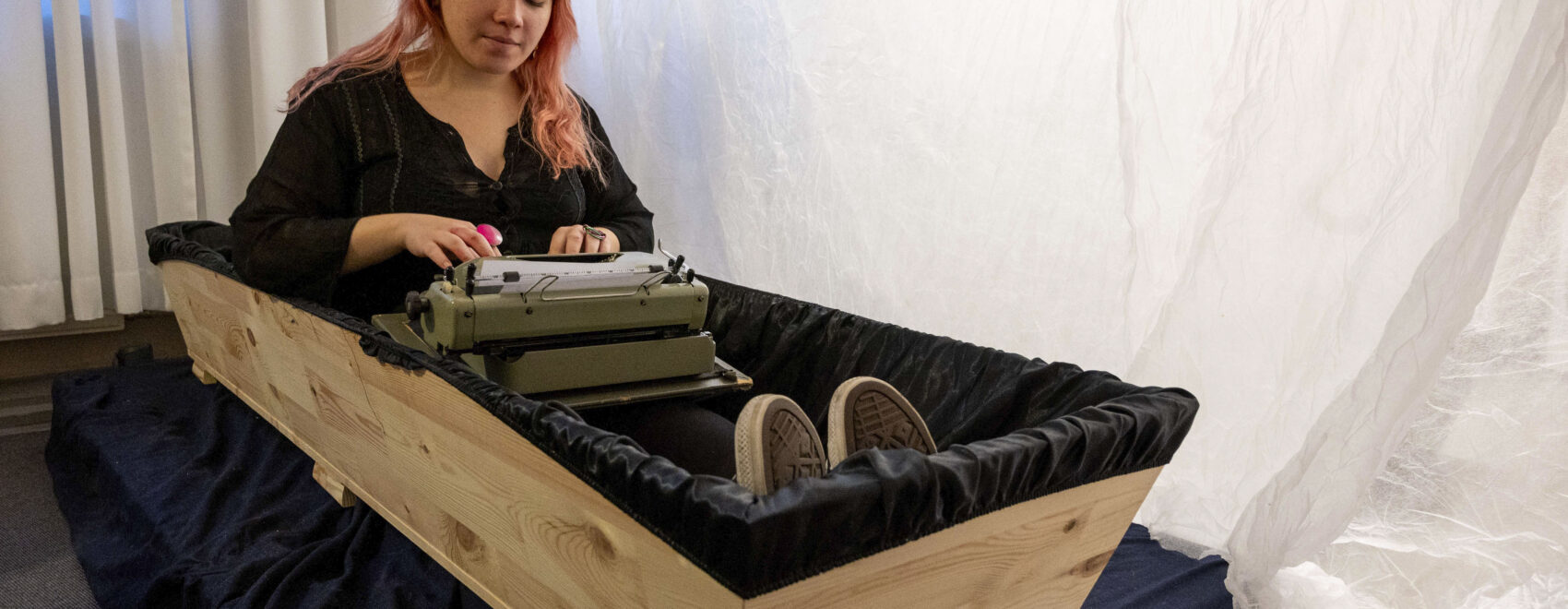
In her essay, Lena Giuliano tells how she ended up writing obituaries for people very much alive around Europe. She took her work Writing on someone’s grave to all the three annual events of the One-to-One art project, in Finland, Croatia and Portugal. Was it different to die in the different corners of Europe?
Versão em português do texto abaixo da versão em inglês.
writing on Europeans’ grave
Lena Giuliano
OBITUARY
Keumbyul Lim died in the middle of the road. She was travelling once again, as she did many many times. She experienced the cold of Antarctica and the heat of the desert. She saw the immensity of Earth in so many textures and colors. The animals by the road watched her death. It was Keumbyul’s last performance. They danced and sang after eating her body. Her loved ones noticed she was gone because she didn’t call them to say goodnight, as she did everyday. All the people, nature and animals can say it back to her now: good night, Keumbyul.
OBITUARY
Roosa died from a walnut, the sweetest walnut she ever had. She made it prepare to die a calm and tasty death. On her food, she was kind of a bird. But also on her freedom. Roosa had important research on the relation between art and nature and created beautiful artworks inspired by such as beautiful landscapes. Now, Roosa is probably flying out there as a bird, playing with little balls, eating nuts and visiting forests and funerals.
OBITUARY
Timo died surrounded by lovely people. There were lots of hands willing to hold his. In life, he organized lots of events, but his funeral was not one of those. His children throw him a beautiful celebration. Timo swam in different lakes, rivers and seas, touched the softest hairs, tasted the coldest snowflakes and wrote the most passionate love poems dedicated to his children, who read it all at the funeral.
*
A young woman in her early twenties, with pink hair and eye-catching earrings and rings, welcomes you into a room. That woman is me — about to write your obituary. You’ve probably been waiting outside for a while, watching people leave the room every twenty minutes, visibly moved, as if they had just met with a healer. I sit at a small table, where a typewriter, a lamp, and a few papers are scattered. Next to me stands an open, empty coffin, quietly inviting you inside. In just a few minutes, it will be you lying there. “Writing on Someone’s Grave” is the only performance piece that connected all three points of the One-to-One Art project: the residency at Kuca Klajn in Klanjec, Croatia; the Keha Festival in Oulu, Finland; and the One-to-One Festival in Oeiras, Portugal. Later, in March 2025, I spent eight days writing obituaries during the Farofa do Processo showcase in São Paulo — the city where I was born, raised, and still live today.
First, I invite you to sit in the armchair across from me. I introduce myself and explain how it works: I’ll ask you a few questions about your life and death — you can answer however you wish, with truths, lies, or pure invention. Then, I’ll invite you to lie down in the coffin while I write your obituary based on what you shared. I hand you a piece of paper and ask you to write your name — exactly as you want it to appear in the text. Some people write their full names; others use only a nickname; the more superstitious invent a completely fictional name. When I ask for your age, it’s often where I sense if someone is lying — fake ages rarely match their faces.
Then come the deeper questions, asked always with kindness, curiosity, and careful listening, trying to create a space where you can be as comfortable as possible: What are your dreams and aspirations? Is there something that you really enjoy doing, that you want to do until your last day alive? What do you think there is after death? If you could choose, how would you choose to die? Do you have any wishes for your body after you have died? And do you have any wishes for your funeral? At the end of our ten-minute conversation, I ask you to choose two songs to play while you lie down inside the coffin, that will be played out loud, on a speaker, just like at a funeral. That’s the time I have to write your obituary. When I’m done, I take a photo, read it aloud to you, and hand over the text. Now, it belongs to you.
The end of the performances does not have standing ovations. It’s a funny interaction. Usually, people thank or compliment me in a kind of feedback while lying inside the coffin. Most get up and give me a hug. Or they stay a little longer and ask me to take a picture of them inside the coffin. When they leave the room, the absence of the audience and the silence of the music expand. And I remain alone for a few minutes, next to the coffin (sometimes I lie down to take a nap, already drained of its meaning).
*
OBITUARY
Danielle Toney is now a pink vibration somewhere in the universe. If you pay attention, you could hear some intense music, maybe with a piano or a flute. It makes you wanna dance in a weird way. Why am I dancing to this song? Danielle was full of joy and great answers. She received many love letters after drowning. Her students were shocked, but she enjoyed floating on clear water. Danielle experienced everything. Felt all the most intense emotions. Her funeral was a reunion to listen to her favourite songs in an ancient forest, where her ashes were thrown. Maybe Danielle will grow into a pink flower.
OBITUARY
Anna-Kaisa has passed along with the sun, watching the night arrive through the window of her room. She was having wine and listening to her own music, an album with a reunion of all her greatest hits. At her funeral, people danced, sang and got drunk to celebrate her life. Anna-Kaisa broke the family superstition and had a long and peaceful life with her sister. Now, they are both growing into big trees by a beautiful river. In silence, they can still hear people laughing.
OBITUARY
Mari died out of the blue in a public park in Oulu. They were turned into an apple tree on the same spot, where children play and run and adults collect fruits to bake apple pies. Mari had a long life full of love. They had great conversations with loved ones, watched lots of great pieces in theatre and ate food so good that made them dance. Despite being a fan of Peter Pan, Mari’s soul and energy are still growing up. Unlike the lost kids, they were very well located in life and death Mari loved and was loved by their friends and family. The apple doesn’t fall far from the tree.
*
When getting up from the coffin, people often ask me where the idea for the performance came from. And the truth is, I don’t really know how to answer. Death has never been a subject that particularly caught my attention. I was never afraid of death. In fact, I always felt it like a friend. And it was only while developing and doing this work that I realized how much death tends to scare people. From people who didn’t even want to enter a room because the scenic coffin was stored there, to others who already found me strange just by hearing about the idea. It’s morbid, funereal, macabre, scary. At the beginning of 2024, I did a theater play where I wrote obituaries for dogs based on their tutors’ accounts. The first obituary was written sitting in a park — where the show took place — right after the conversation about a dog who had died. I quickly scribbled it down on a clipboard. From there, I started envisioning ideas for performances that would begin with someone else’s story and end with a text written quickly in front of them. But there was a question I couldn’t figure out: what would people do while I was writing?
That’s when I went back to the idea of obituaries, and with them, the coffin. So death, in fact, came as an excuse for me to be able to write. But for the audience, death is what calls the most attention. Some people said that sitting in front of me was like sitting in front of death and telling it their wishes, in an almost soothing way. Death was listening carefully and smiling. They also said that the obituary became almost a goal. “I want a death like the one you wrote.” The obituaries always carry a hopeful character. Depending on the openness I sense in each person, I feel more or less freedom to write comedic passages or to exaggerate the facts of death. All texts carry a great load of hope — after all, everyone has the same desires. I came across very few people who were intimately boring, uninteresting, or bad — here, I use this rough word to refer to someone whose intimate desires, even if naively, could harm others. When this happened, it was quite sad. In these cases, I keep my frustrations to myself and listen without apparent judgment. I still write an obituary wanting that person to like it, respecting that other person’s wishes. However, as a general analysis, the exercise of writing obituaries stirred in me a faith in humanity I didn’t possess before. It’s an ant’s work: helping another person to elaborate their death and, with it, to plan their life, awaken their dreams, and make concrete — even if on paper — the possibility of imagining a future.
Having done almost one hundred and fifty obituaries, I have also heard almost one hundred and fifty imaginaries about death. There are some patterns, especially if we think regionally, which I will elaborate further later. The main thing, however, is that everyone speaks about death as if they were right about it, or as if their thoughts were obvious. Many times, one person would affirm something with absolute certainty, and the very next person would state the exact opposite with the same certainty. I always agree with all of them. In my role as death, beside a coffin, my main goal is always to offer comfort by listening very carefully, paying attention without taking notes, not interrupting people’s reasoning line and not contradicting anything they say, only making questions to delve deeper into their thoughts.Each imaginary is very personal and intimate. Even when people belong to a religion, their elaboration on the dogma is very much their own. And most of the time, people are answering these questions for the first time and improvising a personal philosophy.
A very recurring idea is that of the funeral as a happy celebration, a party. It’s the wish of the great majority. Yet, everyone says something like “I don’t want a sad funeral, like everyone else wants.” Which is funny, because almost no one wants a sad funeral. Many people have playlists ready for their funerals and concrete ideas of objects to leave to loved ones: photos, letters. Others have never thought about the subject and don’t want to. There are very few people who want to be buried in a coffin. Most who want to be buried wish to go directly into contact with the earth, aiming to return to nature; otherwise, the greatest desire is to be cremated. And throw the ashes into seas, streets, and forests, or to turn them into seeds and become trees, or into jewelry to wear, or even to ask friends to smoke them.
As I presented at performing arts festivals, a large part of the audience was made up of cultural workers, which influenced their wishes. The dreams of the majority were related to being an artist. They weren’t just dreams of working, but of achieving personal fulfillment through artistic creation, of achieving fulfillment as a person. Many actors, writers, directors had big dreams but jobs outside the arts in order to survive. Some entered the room more convinced that it would be possible “to live only from art”, others less so. Many ideas of dying in the theater, on stage, or in the audience, or of leaving their ashes in those same places. At the same time, because of the audience profile, little was said about marriage and children. When traditional family dreams appeared, they were timid. Many people talked about living with friends, cats, and dogs. The exercise of talking about your aspirations is very important. It helps to make ideas concrete that seem childish and difficult to achieve. Moreover, reading a text written based on those desires makes them even more possible.
Regarding the choice of the way of dying, the most chosen death by far was dying in one’s sleep. Most people want painless and peaceful deaths. However, there are people who are bothered by the idea of dying during sleep because of the impossibility of living a conscious death. These people speak of getting shot or having a heart attack. Something quick, but awake. Some people want a poetic, almost theatrical death, others want to suffer a terminal illness — without losing lucidity — so they can properly say goodbye. And then, there are my favorites: the ridiculous deaths — from people who want their death to become a joke, a funny story in the family. Dying in the middle of a joke, dying walking down the street when a piano suddenly falls on their head.
The idea of what happens after death divides opinions. Many believe that nothing happens and we materially return to nature; others believe in the idea of reincarnation, and most of them believe we can reincarnate as other beings, not necessarily humans; finally, a large number of people believe in some version of the Christian heaven, without the existence of hell. This heaven mostly has nature, loved ones, music, celebration. And above all, no work or money. More than one person said that “heaven is life without capitalism.” People love life as it is, but they don’t love surviving it, and they see in death a hope for a life “with rest”, as I was told over and over again. The construction of an imaginary of life without capitalism is also important for the anti-capitalist struggle, so that this idea of paradise can be attainable in life, without needing to die first. The exercise of imagining your own death carries various personal and collective political urgencies. It is about keeping alive the possibility of invention.
*
OBITUARY
Himalaya died in a very conscious death. He enjoyed the moment and didn’t suffer. Despite the pain, he was laughing and telling jokes. He filmed lots of movies in his last years and was excellent at doing nothing. Directors loved to work with this kind of acting, which was created by Himalaya. He is now floating, swimming, dancing and having the time of his life in space, watching everything like a little camera. Himalaya’s body is buried inside a giant seed, which has grown into a giant tree. People play, eat and rest under his shadow, birds build nests and dogs run around him. Himalaya still carries lots of life.
OBITUARY
Marko died wet and clean, after a long and relaxing bath. He was using bath salts he bought on a street market in Nepal, soaps he bought in the south of France and homemade shampoo from the Amazon Forest. Marko was a well travelled man. He has dived in all seven seas from around the world. And after the swimmings, there was always a cold beer waiting for him. Marko is still wet and travelling. He is everywhere – his ashes are in the ocean. From the beaches in Split, to the coast of every country and then to his final bath. If you pay attention, you can still hear a little trumpet playing underwater.
OBITUARY
Daniel had a long life full of adventures. He travelled all over the world: saw corals of all colors in Australia, flew over new-zealand airs and wandered immensities of snow, ice, sand and salt. What he could, he did on foot. The other, he did on the steering wheel, that was what led him into the precipice where he died. It wasn’t all bad. He was a big cinema fan and honored Thelma and Louise. He had at home lots of stars, some from the cinema, others just from life. His body was donated to science and helped lots of people. His carcass, the rest of the remains, continued on adventures: Daniel was thrown to the pigs and was very well eaten.
*
One of the most beautiful elements of the work, which was proposed and studied by the project between the three institutions, is precisely the one-to-one character. I collect intimacies from people I will never see again in my life. I know about the fears and desires of strangers whom I wouldn’t have even looked at if I had met them on the street. And I also learned new — always touching — layers from dear people I’ve known for years, but with whom I had never touched on the subject of death. One-to-one is a format of performing arts designed for an audience of only one person, in which t e two involved usually produce something together or have some kind of intimate experience. This structure allows the access to the other’s intimacy to be guided lightly, with the other being the one to set the limits of what they want to tell me. Death is lots of times a terrorizing topic, so all the performance is built around the idea of lightening the mood so people can be comfortable with talking about dying and, after that, lying down in a coffin.
According to the British researcher of one-to-one performances Rachel Zerihan, the first experience of this kind was incidental. The performer Chris Burden, in Five-Day Locker Piece (1971), decided to lock himself inside a locker for one hundred and twenty hours. He was surprised by people who would come to talk to him through the locker and tell him personal stories. Almost like a pagan confessional. Around the same time as the boom of performance art in the West, numerous one-to-one experiments emerged, some quite well-known, such as Yoko Ono’s Cut Piece or Marina Abramović’s Rhythm 0.
The one-to-one scene is based not only on the participation of the audience but also on interactivity. The Brazilian PhD in Performing Arts Andrea Saturnino, who is also the general director of Theatro Municipal de São Paulo, says that “Interactive theater is proposed through connections and shifts the real, not in the sense of replicating realities or unveiling unknown worlds, but within us, where the real is constituted and gains meaning.” After writing nearly one hundred and fifty obituaries, I consider that one of the structuring elements of the experience is precisely this openness to the other, which allows the real to shift within the two people forming the one-to-one. It is an openness to the other’s particular universe, embracing any idea of death as possible — after all, there is no certainty on this subject — while maintaining enough distance to avoid being invaded. Compared to Ono’s and Abramovic’s pieces, which I consider are also open to the other, my performance understands that death can be a violent subject and chooses to revert this thought, instead of deepening it.
Several people have told me that I am too young to do a work about death, as if I couldn’t suddenly die halfway through writing this sentence just because I’m twenty-one years old. Death is imminent for everyone. On the other hand, I imagine that old age naturally brings this theme up more frequently, and I have not experienced anything that brought me closer to death more than usual. Acknowledging my inability to fully embrace this topic with the magnitude it deserves, I structured the performance so that the audience would generously offer me their worldview. Andrea Saturnino continues: “The intersubjective relationships created in interactive works can be as or even more powerful than creation models in collective processes. (…) The concept of interactive theater seems to encompass a larger number of works that foresee audience participation in their aesthetic and conceptual experiences, including, in the composition of the performances, subjectivities other than those of the artists. Thus, when analyzing the perspective of those who create the works, interactivity is precisely an openness to the other.”
As with any performance-art, rehearsing is not possible. But in a work so based on interactivity, where the action is built four hands together, even imagining the conduct is imprecise. I did not learn how to perform this piece; each time I do it, I learn in the moment how to do it with that specific person. Just as I did not learn how to write obituaries; instead, I learn, right there, how to write that person’s obituary. Each performance is original. It was even harder to deal with this in São Paulo, where I did it with people very close to me. The idea of writing my parents’ obituaries still makes me apprehensive. I think my biggest difficulty in performing Writing from someone’s grave, in this craft of talking and writing about death, is preparing to welcome the next person. If I do many sessions in a row, I need to take a breath, leave the room, and talk to people about another subject. Sometimes the stories blend together, and exhaustion prevents me from being present. Even so, it is difficult to disconnect during a few minutes of break. I still haven’t learned how to handle it. The one-to-one is the radicalization of that old idea that to make theater all you need is one person in the audience. One person in the audience already makes an entire play. Six people mean two hours I will spend sitting next to the coffin, in front of the typewriter.
*
OBITUARY
Jub died “old, very old,” just as their father had wished. She had a peaceful and painless death while sleeping in a bed in the middle of nowhere. Despite the old age, Jub’s body was completely healthy and was entirely donated to science. The ashes are scattered across the world, along every street where Jub once woke up to drink coffee with milk and eat buttered bread. Today, Jub is probably building rockets and being admired once again in her profession. Jub left behind fascinating podcasts, money in the sock drawer, and diaries filled with her deepest secrets.
OBITUARY
Carla Gomes had a coffin surrounded by red carnations, despite the pink life she lived. Carla was an important theater artist. She traveled all over the world with her performances and made significant contributions to life in Portugal. Her work contributed to the rights of Portuguese women. Carla died peacefully in her sleep, after a day swimming in the Lusitanian seas, where she encountered a Portuguese caravel. Carla is gone, but her memory in life and art remains. A gente vai continuar.
OBITUARY
Aino Maria Granlund died at a very old age, in a very pacific death. Her disease never interrupted her life and only made her think more about life. Aino had an amazing life full of love. She loved a lot and was even more loved. At her funeral, her children hosted a beautiful ceremony, full of people who could experience Aino’s love. It was a privilege. Now, Aino is forever enjoying the forest, the cabinet and the lovely journey between the lake and the sauna, along with herbrother. In life, people can still feel her love.
*
The death, the coffin and the obituaries are all excuses to fulfill a much greater desire: to write on stage. For months, I have been on an intimate quest to discover why writing is so dear to me that I want to bring it to the stage. And I still don’t really know where to start this search, but what I would like to do in this text is to share some conclusions about the craft that I perform with great tranquility. The truth is that writing on stage, improvising, has never scared me. I entered as calmly the first time as I did the last, and it is always very pleasant.
The first thing is the material: the typewriter. It is more than an object on stage. It is a device, a producer of subjectivities, bringing peace through acceptance. It is not possible to erase words on a typewriter. There is no option to start over or go back. Time is short, there are no second chances. The only possibility is to correct a letter here or there, but never entire sentences. This is liberating for me because it forces me to write without looking back. Furthermore, the paper — which in those minutes is all I have — will soon be handed over to the person who will be resurrected from the coffin. I will never see that text I just wrote again — only through photos, which I take of all the obituaries. I can write without worries. What I write here may mean a lot to someone else, but it doesn’t have to mean anything to me.
Concretely, the ritual for writing the obituaries is to play the music on my phone screen, type the word “obituary” at the top center of the page, and right after, on the next line, type the name handwritten by the person themselves. From that moment, I find the addictive sensation I pursue like a drug where inspiration does not meet my reason, nor my emotion, but the mechanical movement of my hands typing on a keyboard, a typewriter, or on paper. At the moment when inspiration — this divine force — finds me, I am what I write, and what I write is me. When I finish, I am alone again, and what I wrote has a life of its own beyond me. These moments where I merge with the words are my incessant search.
Often I find it; sometimes it comes easily, other times it takes longer. It almost never comes, actually, the moment I sit down willing to write. The thought that leads to inspiration comes in moments of idleness — like in the shower, in bed before sleeping, on public transport — or in moments when I am hyper-stimulated by the world around me, such as during plays, delightful books, or festive nights. In the performance “Writing in Someone’s Grave,” I found a technology that controls inspiration and invites it into my body at the exact moment it is needed. When I write on stage, under pressure, I feel like I’m in rain boots, stretching my legs and propelling my body to jump through puddles of water. And I always end up having fun inevitably getting wet.
Who describes this sensation better than I do is the Mexican poet Octavio Paz, in the book The Bow and the Lyre: “Surrendered ‘to the inexhaustible flow of murmuring,’ with eyes closed to the external world, the poet writes without stopping. At first, the sentences get ahead or lag behind, but little by little the rhythm of the writing hand matches the rhythm of the dictating thought. Fusion has been achieved; there is no longer a distance between thinking and saying. The poet loses consciousness of the act he performs: he no longer knows whether he writes or not, nor what he writes. Everything flows happily until an interruption occurs: there is a word — or the opposite of a word: a silence — that blocks the way. The poet tries repeatedly to overcome the obstacle, to go around it, to dodge it somehow and move on. It is useless: all paths lead to the same wall. The source has stopped flowing. The poet rereads what he has just written and discovers, not without astonishment, that the intricate text possesses a secret coherence. The poem has an undeniable unity of tone, rhythm, and temperature. It is a whole. Or fragments, still alive, still glowing, of a whole. But the unity of the poem is not physical or material; tone, temperature, rhythm, and images have unity because the poem is a work. And a work, every work, is the result of a will that transforms and subjects the raw material to its ends. In this text, where critical consciousness barely participated, there are repeated words, images that birth others according to certain tendencies, sentences that seem to stretch their arms seeking an intangible word. The poem flows, advances. And this flowing is what gives it unity.”
What helps me in my craft is the constant work that I do outside of it. For example, finding a balance between confidence in my own work and the insignificance of it. In the end, it is just a paragraph written in thetime it takes to listen to two songs. To write on stage, I adopt an attitude of living an active writing life and do not keep texts in the drawer. I am very interested in being read, criticized, questioned, and willing to defend and oxygenate my text. I only read the obituary I wrote when I read it out loud to the person lying in the coffin. I experience the text along with its intended audience. It is necessary to build self-esteem in the work, a confidence to be worked on daily in the act of writing that is not shaken by my own thoughts or by the criticism of others, without ceasing to listen to it.
Another task I constantly work on in my life is being a porous person. Of course — almost obviously — it is important to fill oneself with artistic and cultural references. Anyone, especially those interested in writing, knows that it is necessary to read, go to the theater, to the cinema, to museums. However, I would like to highlight the less erudite, more unexpected cultural experiences, or even those of leisure. I believe that a porous person is one who is capable of transforming everyday events into experiences. One who listens to a conversation in the subway car and becomes interested in those strangers, who hears a song on a sidewalk and is moved by the lyrics, who is committed to turning any weekend outing into an unforgettable night. When the poet encounters the blank page, it is those things that materialize on paper: the conversations, the songs, the weekend outings.
The Spanish philosopher Jorge Larrosa Bondía gave a description of what the subject of experience would be, which I reclaim here, in a famous lecture at Unicamp, an important Brazilian university: “Experience, the possibility that something happens to us or touches us, requires a gesture of interruption, a gesture that is almost impossible nowadays: it requires stopping to think, stopping to look, stopping to listen, thinking more slowly, looking more slowly, listening more slowly; stopping to feel, feeling more slowly, lingering on details, suspending opinion, suspending judgment, suspending will, suspending the automatism of action, cultivating attention and delicacy, opening the eyes and ears, speaking about what happens to us, learning slowness, listening to others, cultivating the art of encounter, being silent a lot, having patience and giving oneself time and space. (…) The subject of experience is defined not by his activity, but by his passivity, his receptivity, his availability, his openness. However, it is a passivity prior to the opposition between active and passive, a passivity made of passion, of suffering, of patience, of attention, as a primary receptivity, as a fundamental availability, as an essential openness.”
I always say that my two favorite things in the world are studying and partying. The typewriter, for example, was bought between one carnival block and another. And all my artistic work is directly influenced by the fact that I love parties. I love to dance a lot, to sing loudly, to walk through the streets, to spend hours talking about nothing with my friends and even with strangers. I treat the parties as something sacred. I go prepared with objectives and methodologies, just as I do when going to a classroom or opening the pages of a book. I grew up in Brazil, so I have a postgraduate degree in Carnival. The party cannot be wasted; I constantly seek purposes, openness to experiences, and try to leave with a full heart and a story to tell. I do not leave home for nothing. And here I am not associating the party with drug use, but with the unexpected encounters that only this environment provides. Like poetry, the party is also a device that displaces us from ourselves.
I believe that this attitude towards parties directly influences my attitude toward the page. Countless times I have arrived home sweaty after hours of dancing but with an immense urge to write. The texts that stay with me, that are not delivered to any audience, are usually written late at night in the state of farewell to euphoria. They are not reports about the night’s events — on the contrary. It is about the state of the body, a body that writes, that is not just a guardian of a genius mind. I think what I am trying to reclaim is a poetic work of life that goes beyond the page and, in this case, returns to it. Again, I call upon the same book by Octavio Paz:
“The poetic operation is inseparable from the word. To poetize is, first and foremost, to name. Theword distinguishes the poetic activity from all others. To poetize is to create with words: to make poems. The poetic is not something given, not something man is born with, but something man makes and which, reciprocally, makes man. The poetic is a possibility, not a priori category nor an innate faculty. But it is a possibility we create by ourselves. By naming, by creating with words, we create that which we name and which before existed only as threat, emptiness, and chaos. When the poet says he does not know ‘what he is going to write,’ he means he does not yet know the name of that which his poem will name, and which, until named, presents itself as unintelligible silence. Poet and reader create each other through the poem that only exists through and for them. Thus, there are no poetic states, just as there are no poetic words. Poetry is a continuous creation and thus removes us from ourselves, displaces us, and leads us to our most extreme possibilities.”
The performance “Writing in Someone’s Grave” is a tool I used to reframe my relationship with writing. In various long-term writing projects, I found myself anguished by the act of writing. I would sleep and wake up thinking that I had to do this boring task. And I discovered, through writing on stage, that I much prefer writing in minutes rather than months. As I said at the beginning, every time I must answer why I write, I feel extremely lost. To this day, I don’t know. Writing is so deeply within me that I have not yet found ways to distance myself from it in order to start understanding my craft. The Chilean playwright Inés Stranger writes in her book Cuadernos de Dramaturgia: Teoría, técnica y ejercicios that there is something in meaning — a concept for which she offers numerous definitions, but here I choose the one that says meaning is the reason for being — of life and storytelling that only arises when the experience is completed. Maybe that is why I cannot justify my writing, and if so, there is a part of me that never wants to find out.
Thinking on a broader, political, collective level, and in yet another effort by this Latin American artist to bring references from the Global South into a text that will be read in Europe, I choose to end these musings about writing with a quote from the Malian writer Amadou Hampâté Bâ. In the text The Living Tradition, he discusses African societies that prioritize oral traditions over written ones, which the colonialist Western vision judged as a lack of culture: “What lies behind the testimony, therefore, is the very value of the man who bears witness, the value of the chain of transmission of which he is a part, the fidelity of individual and collective memories, and the value attributed to truth in a given society. In short: the link between man and word. And so, in oral societies, not only is the function of memory more developed, but also the bond between man and the Word is stronger. Where writing does not exist, man is bound to the word he utters. He is committed to it. He is the word, and the word carries testimony of who he is. The very cohesion of society rests on the value and respect for the word. Conversely, as writing spreads, we see the spoken word gradually replaced, becoming the only proof and resource; we see the signature become the only recognized commitment, while the sacred and deep bond between man and word progressively disappears, giving way to conventional academic degrees.”
This reflection is excellent to remind us that writing — this craft I chose, and which chose me — is much bigger than any typewriter, any book, any library. It is necessary to handle words with great care when choosing to register them on paper. Words do not die. They do not lie down in coffins nor await their obituary. Words are alive, and they claim for their life all the time.
*
OBITUARY
Aleksandar Svabic died while picking meat at the supermarket. The butcher was the first one to see his corpse. Aleksandar was planning a barbecue for his friends and family. He was known for being a great cook and an excellent eater. In his life, Aleksandar had lots of fun, drank lots of red wine and fell in love everyday. His body was used in performances that honored his career as a theatre director. After that, his useful organs were donated to science and helped lots of people. Finally, his body was left in the forest, helping trees to grow and deers to eat. He became like the meat he was buying. Aleksandar had a long death, and, just like in life, made lots of people happier.
OBITUARY
Marko died wet and clean, after a long and relaxing bath. He was using bath salts he bought on a street market in Nepal, soaps he bought in the south of France and homemade shampoo from the Amazon Forest. Marko was a well travelled man. He has dived in all seven seas from around the world. And after the swimmings, there was always a cold beer waiting for him. Marko is still wet and travelling. He is everywhere – his ashes are in the ocean. From the beaches in Split, to the coast of every country and then to his final bath. If you pay attention, you can still hear a little trumpet playing underwater.
OBITUARY
Maria Fernandes died “velhotinha”, in an old age, while sleeping. Her husband threw her ashes at the foot of an orange tree in the backyard of the house they built together. Maria blooms in sweet and perfumed fruits, in the same color as the sunrise sky. She felt fulfilled from a very young age, living an extremely happy life. Today, she continues her adventures in Portuguese fields and beaches turned into an elegant cat that roams alone during the day and is pampered at night. Maria smiled a lot herself, and chose the most beautiful lipsticks to tease the most beautiful smiles in all the people around her.
*
Beyond all the experiences and conclusions that the act of writing obituaries has allowed me to have, there is another very important dimension that inevitably crosses all events. I was born in Argentina, grew up in Brazil, and traveled to Europe to carry out this performance. My friends joke that I went there to deliver justice by (metaphorically) killing Europeans. I came to know three cities and their people through death: Klanjec, a small Croatian town between Zagreb and Ljubljana; Oulu, in northern Finland; and Oeiras, in the metropolitan area of Lisbon. These three immensely different places form the vertices of what is the One-to-One Art project.
In September, I spent twenty days living with Dunja and Jerko, who welcomed me spectacularly into their home, which also serves as a cultural center nestled among the mountains. Alongside me were the artists Eva Holts and Dmytro Grynov. I knew almost nothing about Croatia, other than it being a filming location for Game of Thrones—a TV show I have never watched a single episode of. I could easily pass for Croatian because of my really white skin and, at the time, my reddish hair. I was just like most girls I saw walking through the streets. Perhaps a trend in the region inspired by Dua Lipa, who is Albanian. In desperation, I would say, “Sorry, I don’t speak Croatian.” Even after twenty days immersed in the language—which sounded to me as musical as Italian—I only remember a few words: dobre dan, good morning; hvala, thank you; pivo, beer; and svila, silk, and also the name of the house dog. Just the essentials.
During the residency, we had some scheduled commitments: attending theater and circus performances, meetings about technical needs, and encounters with artists. On the last day, we held an open house for artist friends from the residency, where I was finally able to conduct the experiments I had been planning. The setting was exactly what one imagines for an artist residency: in the middle of the mountains, in a tiny town surrounded by trails. A beautiful horizon, calm and silent streets. Even Zagreb felt small to me—the entire country’s population is smaller than that of São Paulo’s eastern zone, where I grew up and still live today. The house’s generous fridge was always full. I miss ajvar, a pepper and eggplant spread, and burek, a traditional Balkan pastry usually filled with spinach and cheese, commonly eaten during the hangovers of late nights, accompanied by a glass of natural yogurt.
Many afternoons were spent reading and writing about death at the office tables, on the living room armchairs, or on the balcony chairs. At night and at midday, I took every opportunity to flood my hosts with questions. They told me everything about the wars, about Yugoslavia, and about languages, which fascinates me most. In Slovenian, the word for “theater” is associated with the verb to watch; in Croatian, with the verb to show; and in Serbian, with the idea of attention. Literally different ways of seeing theater—which, by the way, is a word of Greek origin, containing the ideas of place and gaze. That kitchen table became a classroom. Within those walls, I was truly treated as an artist, with dignity and respect for the time needed to create, for the inevitable crises, and for dialogue that always brought new ideas and references from every corner of the world.
The second stop of this adventure was Oulu, a city that immediately enchanted me with the first images I found online. It has a real winter, an irresistible phenomenon for anyone born near the equator. Although known in Finland as the “Shitty City,” it gave me wonderful experiences. Our first day was spent in a winter cabin like the ones I had only seen illustrated in children’s books. Wooden walls, colorful wool socks loaned to us by the festival’s organizers, a fully vegan lunch. Everyone was very welcoming, especially Aino and Timo, who led the activities. After just two days in Finland, it already felt like I had been there for months. I tasted cloudberries, raspberries, blueberries—every kind of berry offered to me. I saw children walking alone down the streets without concern, and robots delivering food. The future arrives early in the North.
On the first day of the festival, I went to pick up the coffin from a festival warehouse across the river. It was considered far by Oulu standards—by São Paulo standards, it was right next door. I saw the river just beginning to freeze, bare trees, footprints in the distant snow. It was beautiful to watch the city preparing for the coming cold. People told me it was the first snow of the year, and we hoped together that it would snow again while I was still there – and it did! Several told me they wished they could experience their first snowfall as adults, as I was. Snow had lost its magic through age.
One of the festival directors told me he had seen more northern lights in his life than rainbows. Snow for the Finnish holds no magic—it’s a bother. Skiing is just another boring school sport. The idea of a tropical December seemed completely alien to many I met. How could Christmas be spent in a tank top, or New Year’s jumping ocean waves? They’ve never looked down; we’ve – by we, I mean all of us from the Southern countries – strained our necks from looking up. Snow-covered streets, Christmas pines, reindeer, sleighs, Halloween pumpkins— the winter arrives early in Oulu — all tragically familiar. We are constantly celebrating a culture that was pushed onto us. Recently the Brazilian actress Fernanda Torres explained to me my own feelings in an interview: I feel both pity for them and anger at them that my culture isn’t celebrated too.
Which finally brings me to Portugal—a country with whom I share a language, foods, surnames, and a horrific history. Everything felt somewhat familiar. The ocean I saw from my hotel window was the same I see in Brazil, but from the other side. The bridge spanning the city, I knew from photos; the river beneath it, I knew from poems. Some compliments were new: que fixe!, que giro! And some everyday expressions were charmingly poetic, like pequeno almoço, like little lunch, for breakfast, or chapéu de chuva, like a rain’s hat, instead of guarda-chuva, a rain’s keeper, for the word umbrella. I found Brazilians waiting for tables and driving Ubers; Brazilian music playing in bars and on corners. I found Brazil in many Portuguese people, too—those obsessed with Brazilian memes. They finally had someone who understood all the jokes beyond the internet. The scars of colonization were subtle, like the fact that the festival was held at the Barcarena Gunpowder Factory, inaugurated in 1540. We still breathe that dust. I believe no Brazilian has ever been treated as kindly in that place as I was, thanks to Ana, David, and everyone involved in the production.
Where I come from, it’s common to think of all European countries as very similar—a way to return the stigmas Northern countries place on Southern ones. But traveling through these places, I noticed especially stark differences in how death is imagined. In Oulu, there was a deep concern for the environment when considering the destination of one’s body after death. In Portugal, that concern existed but wasn’t a barrier to imagining personal wishes. In Finland, it often was. The landscapes cultivated in their visions of paradise mirrored their actual geographies. In Finland, paradise was a snowy forest with lakes and cabins; in Portugal, warm beaches; in Croatia, a blend—sometimes beaches, sometimes mountains.
As expected, in Finland I felt people were generally much happier than elsewhere. They seemed less worried about their futures, careers, or desires to build families. In Croatia and Portugal, uncertainty and anxiety loomed larger, fueled by fears that artistic dreams might never be realized under capitalism’s pressures. In Portugal and Croatia, there was a strong desire to migrate elsewhere. In Portugal, I heard some unsettling comments, disguised behind friendly smiles. Some elderly men sincerely expressed dreams of retracing the routes of imperial conquest, or moving to other once-powerful empires. They praised Brazil as “a great achievement of our empire” revealing a dangerous and persistent nationalism.
Returning to Brazil, I noticed something funny. When I asked people what they wished to do before their last day, many answered: have sex. No one said that in Europe. I also heard many expressing the desire to die in the middle of a Carnival block party. I love that idea. That’s how I want to die: suddenly, during Carnival, in the streets, in a moment of pure happiness. And I want each of my loved ones to write an obituary for me at my funeral, on my own typewriter. I want to have many, many obituaries written in my name. And then I want them to burn my body along with these obituaries, with the words of my loved ones laid on my body. With the ashes, maybe throw them in between the pages of books waiting for life on library shelves all around the world.
*
OBITUARY
Hilla Harju died reading on her couch at a very old age. All of her enormous family was reunited in her house in Lapland. Her children were wearing wool sweaters she made and her grandchildren were playing with the sheeps. Hilla had a long life full of love. After dying, she received a big homage from all the students she ever taught. Her funeral was very crowded. Now, she is probably growing apples in the form of a tree and stills making people happy.
OBITUARY
Eerika died at a very old age. She was meditating with her sister when she passed. In her last years, she could spend most of the time at her house, dancing and reading to her children. Eerika was buried directly to the ground, covered by an ocre woolen cape her friends made. In Eerika’s death, she was never cold, and also never bored. She is dancing now with Bob Marley, having a good laugh. Her loved ones remember her joy. No woman, no cry.
OBITUARY
Fátima Dias died in her house surrounded by loved ones; her children, grandchildrens and her husband. They did with Fátima the same she had done her whole life in her profession. She was known as a good nurse, a great mother, and an excellent grandmother. In her life, she shone on stage with dramas, comedies, songs and cavaquinhos. In her death, on the other hand, she remains in the wings, peeking behind the curtain at what is happening with the people she loves, those who took such good care of Fátima in her life and continue treating her with the same generosity in her death.
References:
*BÂ, Amadou Hampâté. A tradição viva. In:KI-ZERBO, Joseph (Org.).História Geral da
África I. 2010.
*BONDÍA, Jorge Larrosa. Notas sobre a experiência e o saber de experiência. 2002.
*PAZ, Octavio. The bow and the lyre. 1956.
*SATURNINO, Andrea. Ligeiro deslocamento do real. 2021.
*ZERIGAN, RACHEL. One to one Performance: a study room guide on works devised for an audience of one. 2009.
escrevendo na cova de europeus
Lena Giuliano
OBITUARY
Keumbyul Lim died in the middle of the road. She was travelling once again, as she did many many times. She experienced the cold of Antarctica and the heat of the desert. She saw the immensity of Earth in so many textures and colors. The animals by the road watched her death. It was Keumbyul’s last performance. They danced and sang after eating her body. Her loved ones noticed she was gone because she didn’t call them to say goodnight, as she did everyday. All the people, nature and animals can say it back to her now: good night, Keumbyul.
OBITUARY
Roosa died from a walnut, the sweetest walnut she ever had. She made it prepare to die a calm and tasty death. On her food, she was kind of a bird. But also on her freedom. Roosa had important research on the relation between art and nature and created beautiful artworks inspired by such as beautiful landscapes. Now, Roosa is probably flying out there as a bird, playing with little balls, eating nuts and visiting forests and funerals.
OBITUARY
Timo died surrounded by lovely people. There were lots of hands willing to hold his. In life, he organized lots of events, but his funeral was not one of those. His children throw him a beautiful celebration. Timo swam in different lakes, rivers and seas, touched the softest hairs, tasted the coldest snowflakes and wrote the most passionate love poems dedicated to his children, who read it all at the funeral.
OBITUARY
Eerika died at a very old age. She was meditating with her sister when she passed. In her last years, she could spend most of the time at her house, dancing and reading to her children. Eerika was buried directly to the ground, covered by an ocre woolen cape her friends made. In Eerika’s death, she was never cold, and also never bored. She is dancing now with Bob Marley, having a good laugh. Her loved ones remember her joy. No woman, no cry.
*
Uma garota de vinte e poucos anos e cabelo rosa, com brincos e anéis chamativos te convida a entrar em uma sala. Sou eu, prestes a escrever o seu obituário. Você provavelmente está esperando há algum tempo do lado de fora, vendo pessoas saírem emocionadas da sala a cada vinte minutos como se lá dentro fosse um consultório de alguma curandeira. Ela se senta em uma mesa que segura uma máquina de escrever, uma abajur e alguns papéis. Ao seu lado, um caixão aberto, vazio, te convidando a entrar. É você quem vai entrar nele daqui a poucos minutos. “Escrevendo na cova de alguém” é a única performance que integrou as três vértices do One to One Project: a residência em Kuca Klajn, em Klanjec, Croácia, o Keha Festivaali, em Oulu, Finlândia, e o One
to One Festival, em Oeiras. E depois, em março de 2025, escrevi obituários durante oito dias na Mostra Farofa do processo, em São Paulo, a cidade onde cresci e moro até hoje.
Te convido, primeiro, a sentar-se na poltrona à minha frente. Me apresento e explico a dinâmica: primeiro vou te fazer algumas perguntas sobre sua vida e sua morte, que você pode me responder do jeito que quiser, com verdades, mentiras ou ficções. Depois, vou te convidar a deitar no caixão enquanto eu escrevo o seu obituário com base nas respostas que você me deu. Te peço para escrever seu nome em um papel, do jeito que você quer que esteja no texto. Ali, algumas pessoas escrevem o nome inteiro, outras apenas um apelido, e ainda tem supersticiosos que escrevem um nome fictício, obviamente inventado. Pergunto o seu nome – é nessa pergunta que descubro se você está mentindo, porque as idades falsas sempre são bem dissonantes das aparências.
Aí começam as perguntas mais profundas, sempre com carisma, carinho e escuta atenta, na tentativa de alcançar o maior conforto possível: Quais são seus sonhos e aspirações? Tem alguma coisa que você gostaria de fazer até o seu último dia de vida? O que você acha que tem depois da morte? Se você pudesse escolher, como você escolheria morrer? Você tem algum desejo para seu corpo depois da morte? Você tem algum desejo para o seu funeral? Por fim, ao fim dessa conversa que dura em torno de dez minutos, eu te peço para escolher duas músicas para ouvir enquanto você deita no caixão. Esse é o tempo que eu tenho para escrever o obituário. Ao terminar, tiro uma foto, leio em voz alta e te entrego o texto, que agora é seu.
*
OBITUARY
Katja died at an old age, surrounded by her boys. Her body was warm and she left in peace. For half of her life, she felt a safety she never thought was possible. She woke up happy and prepared for what was coming. Katja didn’t like surprises, but her boys threw her a great one. They scattered their mom’s ashes on a sunny beach, so she never had to feel cold again. Katja is now relaxing somewhere, with a warm soul and a loved heart.
OBITUARY
Danielle Toney is now a pink vibration somewhere in the universe. If you pay attention, you could hear some intense music, maybe with a piano or a flute. It makes you wanna dance in a weird way. Why am I dancing to this song? Danielle was full of joy and great answers. She received many love letters after drowning. Her students were shocked, but she enjoyed floating on clear water. Danielle experienced everything. Felt all the most intense emotions. Her funeral was a reunion to listen to her favourite songs in an ancient forest, where her ashes were thrown. Maybe Danielle will grow into a pink flower.
OBITUARY
Anna-Kaisa has passed along with the sun, watching the night arrive through the window of her room. She was having wine and listening to her own music, an album with a reunion of all her greatest hits. At her funeral, people danced, sang and got drunk to celebrate her life. Anna-Kaisa broke the family superstition and had a
long and peaceful life with her sister. Now, they are both growing into big trees by a beautiful river. In silence, they can still hear people laughing.
OBITUARY
Mari died out of the blue in a public park in Oulu. They were turned into an apple tree on the same spot, where children play and run and adults collect fruits to bake apple pies. Mari had a long life full of love. They had great conversations with loved ones, watched lots of great pieces in theatre and ate food so good that made them dance. Despite being a fan of Peter Pan, Mari’s soul and energy are still growing up. Unlike the lost kids, they were very well located in life and death. Mari loved and was loved by their friends and family. The apple doesn’t fall far from the tree.
*
Ao levantar-se do caixão, as pessoas costumam me perguntar de onde surgiu a ideia da performance. E a verdade é que não sei responder direito. A morte nunca foi um assunto que me chamou atenção. Nunca tive medo da morte. Na verdade, sempre a senti como uma amiga. E foi apenas elaborando e fazendo esse trabalho que tive a percepção de que a morte costuma assustar muito as pessoas. Desde pessoas que não quiseram adentrar uma sala porque o caixão da cenografia estava lá guardado, até quem já me achou esquisita só por contar a ideia do trabalho. É mórbido, fúnebre, macabro, assustador. No início de 2024, fiz uma peça de teatro onde escrevi obituários de cachorros a partir de relatos de seus tutores. O primeiro obituário foi escrito sentada em um parque, onde era o espetáculo, logo após ter a conversa sobre a cachorra que morreu. Escrevi com garranchos rapidamente em uma prancheta. A partir daí, comecei a vislumbrar ideias de performances que se iniciariam com o relato de outra pessoa e terminariam com um texto escrito rapidamente na frente dela. Mas havia uma questão que eu não conseguia fechar: o que as pessoas fariam enquanto eu escrevia?
Aí voltei aos obituários, e com eles veio o caixão. Então a morte, na verdade, veio como uma desculpa para que eu pudesse escrever. Mas para o público a morte é o que mais chama. Algumas pessoas disseram que sentar-se na minha frente era como sentar-se em frente da morte e contar-lhe os seus desejos, de um modo quase tranquilizador. A morte estava ouvindo atentamente e sorrindo. Também disseram que o obituário se tornava quase um objetivo. “Quero uma morte como a que você escreveu”. Os obituários sempre carregam um caráter esperançoso. Dependendo da abertura que percebo em cada pessoa, me sinto com mais ou menos liberdade para escrever passagens cômicas ou para exagerar os dados da morte. Todos os textos carregam uma carga grande de esperança, afinal, todo mundo tem os mesmos desejos. Me cruzei com poucas pessoas intimamente chatas, desinteressantes ou ruins – aqui, utilizo essa palavra tosca para me referir a alguém que tem desejos íntimos que, mesmo que ingenuamente, podem ferir outras. Quando isso aconteceu, foi bem triste. No entanto, como análise geral, o exercício de escrever obituários nessa intimidade me despertou uma fé na humanidade que antes eu não tinha. É um trabalho de formiguinha ajudar a outra pessoa a elaborar a sua morte e, com ela, a planejar a sua vida, despertar seus sonhos, concretizar em algum lugar – no papel, que seja – a possibilidade de um futuro em que imaginar é possível.
Tendo feito quase cento e cinquenta obituários, ouvi também quase cento e cinquenta imaginários sobre morte. Existem alguns padrões, especialmente se pensarmos por região, que vou elaborar mais adiante. O principal, no entanto, é que todas as pessoas falam sobre a morte como se estivessem certos, ou como se seus pensamentos fossem óbvios. Várias vezes tive uma pessoa que afirmou com toda a certeza do mundo sobre algo, e logo em seguida a próxima pessoa falou com a mesma certeza o pensamento contrário. Eu sempre concordo com todas elas. No meu papel de morte, ao lado de um caixão, meu objetivo principal sempre é o acolhimento. Cada imaginário é muito pessoal e íntimo. Ainda quando as pessoas fazem parte de uma religião, sua elaboração sobre o dogma é muito própria. E na maioria das vezes, as pessoas estão respondendo essas perguntas pela primeira vez e improvisando uma filosofia autoral.
Uma ideia bastante recorrente é a do enterro como celebração feliz, como festa. É um desejo da grande maioria. E ainda todos dizem algo como “não quero um enterro triste, como todos querem”. O que é engraçado porque quase ninguém quer um enterro triste. Muitas pessoas têm playlists prontas para seus funerais, e ideias concretas de objetos para deixar para pessoas queridas, fotos, cartas. Outras nunca pensaram sobre o assunto e não querem. Existem, ainda, pouquíssimas pessoas que querem ser enterradas em um caixão. A maioria que quer ser enterrada gostaria de ir direto em contato com a terra, em um objetivo de retornar à natureza; senão, o grande desejo é o de ser cremado. Com as cinzas, jogar em mares, ruas e florestas, ou transformá-las em semente e virar árvore, ou em jóias para vestir, ou ainda pedir para que amigos as fumem.
Como apresentei em festivais de artes cênicas, grande parte do público era trabalhador da cultura, o que dita os desejos. Os sonhos da grande maioria tinha a ver com ser artista. Não eram sonhos apenas de trabalhar, mas de conseguir se realizar pessoalmente através da criação artística, de se realizar como pessoa. Muitos atores, escritores, diretores com grandes sonhos e trabalhos fora dessa área para conseguir sobreviver. Alguns chegavam na sala acreditando mais que seria possível “viver apenas da arte”, outros menos. Muitas ideias de morrer no teatro, no palco ou na plateia, ou de deixar suas cinzas nesses mesmos lugares. Ao mesmo tempo, por ser um público com esse perfil, pouco se falou em casamento e filhos. Quando apareciam os desejos de querer formar uma família nos moldes tradicionais, eles eram tímidos. Muitas pessoas falavam de morar com amigos, gatos, cachorros. O exercício de falar sobre suas aspirações é muito importante. Ele ajuda a concretizar ideias que parecem desejos infantis e pouco realizáveis. E ainda, ler um texto escrito fundamentado por esses desejos os torna ainda mais possíveis.
Na questão sobre a escolha do jeito de morrer, a morte mais escolhida foi, de longe, dormindo. A maioria quer mortes indolores e pacíficas. Há, no entanto, pessoas que se incomodam com a ideia de morrer durante o sono pela impossibilidade de viver uma morte consciente. E aí falam sobre levar um tiro ou ter uma parada cardíaca. Algo rápido, mas acordado. Tem pessoas que querem uma morte poética, quase cênica, outras, que querem sofrer alguma doença terminal – sem perder a lucidez – para poder despedir-se da vida. E ainda, tem as minhas favoritas: as mortes ridículas, de pessoas que querem que sua morte seja piada, que vire uma história engraçada na família. Morrer no meio de uma piada, morrer andando na rua quando um piano repentinamente cair na cabeça.
A ideia do pós-morte divide opiniões. Muitos pensam que não acontece nada e voltamos materialmente para a natureza; outros acreditam na ideia de reencarnação, e a maioria destes acredita que podemos reencarnar como outros seres que não são humanos; por fim, uma grande quantidade de pessoas pensa em algum desdobramento do paraíso cristão, sem a existência do inferno. Esse paraíso tem em sua maioria natureza,
pessoas amadas, música, festa. E, sobretudo, não têm trabalho nem dinheiro. Mais de uma pessoa disse que “o paraíso é a vida sem o capitalismo”. As pessoas gostam da vida como ela é, mas não gostam de sobreviver, e vêem na morte uma esperança de uma vida “com descanso”, como foi me dito várias e várias vezes. A construção de um imaginário de vida sem o capitalismo também é importante para a luta anti-capitalista, para que essa ideia de paraíso seja possível de ser alcançada em vida, sem precisar morrer antes. O exercício de imaginar sua própria morte carrega diversas urgências políticas pessoais e coletivas. É manter viva a possibilidade da invenção.
*
OBITUARY
Himalaya died in a very conscious death. He enjoyed the moment and didn’t suffer. Despite the pain, he was laughing and telling jokes. He filmed lots of movies in his last years and was excellent at doing nothing. Directores loved to work with this kind of acting, which was created by Himalaya. He is now floating, swimming, dancing and having the time of his life in space, watching everything like a little camera. Himalaya’s body is buried inside a giant seed, which has grown into a giant tree. People play, eat and rest under his shadow, birds build nests and dogs run around him. Himalaya still carries lots of life.
OBITUARY
Marko died wet and clean, after a long and relaxing bath. He was using bath salts he bought on a street market in Nepal, soaps he bought in the south of France and homemade shampoo from the Amazon Forest. Marko was a well travelled man. He has dived in all seven seas from around the world. ANd after the swimmings, there was always a cold beer waiting for him. Marko is still wet and travelling. He is everywhere – his ashes are in the ocean. From the beaches in Split, to the coast of every country and then to his final bath. If you pay attention, you can still hear a little trumpet playing underwater.
OBITUARY
Daniel teve uma vida longa e cheia de aventuras. Viajou por todo o mundo: viu corais de todas as cores na Austrália, saltou pelos ares da Nova Zelândia e percorreu imensidões de neve, gelo, areia e sal. O que pôde, fez a pé. O outro, fez ao volante, que foi o que o levou ao precipício onde morreu. Não foi de todo mal. Era um grande fã de cinema e homenageou Thelma e Louise. Tinha em casa muitas estrelas, algumas de cinema, outras apenas da vida. Seu corpo foi doado à ciência e ajudou muitas pessoas. Sua carcaça, o resto dos restos, seguiu em aventuras: Daniel foi jogado aos porcos e foi muito bem comido.
OBITUÁRIO
Mônica Mendes morreu de um tiro na testa e, curiosamente, teve seus minutos mais prazerosos em seu leito, experimentando coisas que deixou especialmente para este momento. Mônica se sentiu bem realizada desde cedo. Contribuiu para o bem-estar da fauna e flora portuguesa e foi uma excelente mãe. Sempre correu com os lobos,
decidida, sabia o que queria. Hoje, ela corre em matilha, feito loba de verdade, no norte de Portugal. Muitas coisas a fazem sorrir. Foi muito feliz. E ainda será. Mônica voltará…
*
Um dos elementos mais lindos do trabalho e que foi proposto e estudado pelo projeto é justamente o caráter one to one. Coleciono intimidades de pessoas que nunca mais vou ver na vida. Sei sobre medos e desejos de desconhecidos que não teria nem olhado se encontrasse na rua. E também aprendi novas camadas – sempre emocionantes – de pessoas queridas que conheço há anos, mas com quem nunca havia tocado no assunto da morte. O one to one é um formato de arte cênica pensado para um público de uma pessoa só, em que as duas pessoas envolvidas comumente produzem algo juntos ou tem algum tipo de experiência íntima. Essa estrutura permite conduzir o acesso às intimidades do outro com leveza e com a possibilidade de que o outro seja o impositor dos limites.
Segundo a pesquisadora britânica de performances one to one Rachel Zerihan, a primeira experiência desse tipo foi incidental. O performer Chris Burden, em Five-Day Locker Piece (1971), decidiu se trancar dentro de um armário por cento e vinte horas. Ele foi surpreendido por pessoas que chegavam para conversar com ele do outro lado do armário e contar-lhe histórias pessoais. Quase como um confessionário pagão. Nessa mesma época do boom da performance-arte no Ocidente, surgiram inúmeras experimentações one to one, algumas bastante conhecidas, como a Cut Piece de Yoko Ono ou Ritmo 0 de Marina Abramovic.
A cena one to one se pauta não apenas na participação do público, mas também na interatividade. A brasileira doutora em Artes Cênicas Andrea Saturnino, que também é diretora geral do Theatro Municipal de São Paulo, diz que “O teatro interativo propõe-se a partir de conexões e desloca o real, não no sentido de replicar realidades ou desvelar mundos que não conhecemos, mas em nós, onde o real se constitui e ganha sentido.” Depois de escrever quase cento e cinquenta obituários, considero que um dos elementos estruturantes da experiência é justamente essa abertura para o outro, que permite deslocar o real dentro das duas pessoas que formam o one to one. É uma abertura para o universo particular do outro, para assumir qualquer imaginário de morte como possível – afinal, não há certeza alguma sobre esse assunto -, ao mesmo tempo que essa abertura é feita com distanciamento, sem se permitir ser invadido.
Ouvi de várias pessoas que sou muito nova para fazer um trabalho sobre morte, como se eu não pudesse morrer repentinamente no meio da escrita dessa frase só por ter vinte e um anos. A morte é iminente para todos. Por outro lado, imagino que a velhice traz naturalmente esse tema com mais recorrência, e também não passei por nenhum acontecimento que me deixou mais próxima da morte do que o normal. Pelo reconhecimento da minha incapacidade de abranger esse assunto com a magnitude que merece, estruturei a performance para que o público me oferecesse com generosidade a sua visão de mundo. Andrea Saturnino continua: “As relações intersubjetivas que se criam nas obras
interativas podem ser tão ou mais potentes que os modelos de criação em processos coletivos. (…) O conceito de teatro interativo parece conseguir abranger um número maior de obras que preveem a participação do público em suas experiências estéticas e conceituais, incluindo, na composição dos espetáculos, subjetividades alheias às dos artistas. Portanto, ao analisar a questão da perspectiva de quem cria as obras, a interatividade é justamente uma abertura para o outro.”
Como em qualquer performance, o ensaio não é possível. Mas em uma obra tão pautada na interatividade, em que a ação é construída a quatro mãos, até a imaginação da condução é imprecisa. Não aprendi a fazer essa performance, cada vez que a faço aprendo no momento como fazê-la com essa pessoa específica. Do mesmo jeito que não aprendi a escrever obituários, e sim aprendo naquele momento a escrever o obituário daquela determinada pessoa. Toda performance é original. Isso foi ainda mais difícil de lidar em São Paulo, já que fiz com pessoas muito próximas a mim. A ideia de escrever o obituário dos meus pais ainda me deixa apreensiva. Acho que minha maior dificuldade na manufatura de “Escrevendo na cova de alguém”, nesse ofício de falar e escrever sobre a morte, é a preparação para receber a próxima pessoa. Se faço muitos seguidos, preciso tomar um ar, sair da sala, conversar com as pessoas sobre outro assunto. Às vezes as histórias se misturam e a exaustão me impede de estar presente. Mesmo assim, é difícil se desligar em alguns minutos de intervalo. Ainda não aprendi a lidar com isso.
O one to one é a radicalização daquela velha ideia de que para fazer teatro basta apenas uma pessoa na plateia. Uma pessoa na plateia já faz uma peça inteira. Seis pessoas significam duas horas que passarei sentada ao lado do caixão, em frente à máquina de escrever. O fim das performances não tem aplausos de pé. É uma interação engraçada. Geralmente as pessoas agradecem ou elogiam em uma espécie de feedback deitadas dentro do caixão. A maioria se levanta e me dá um abraço. Ou ficam um pouco mais e pedem para eu tirar uma foto delas no caixão. Quando saem da sala, a ausência do público e o silêncio da música se expandem. E eu fico por alguns minutos sozinha, ao lado do caixão (às vezes me deito para tirar um cochilo, já me esvaindo de seu significado).
*
OBITUÁRIO
Jub morreu “velha, muito velha”, como desejava seu pai. Teve uma morte pacífica e indolor enquanto dormia em uma cama no meio do nada. Apesar da velha idade, seu corpo estava completamente saudável e foi inteiramente doado à ciência. Suas cinzas estão espalhadas por todo o mundo, por todas as ruas onde um dia acordou para tomar café com leite e comer pão com manteiga. Hoje, Jub está provavelmente construindo foguetes e sendo admirade mais uma vez em sua profissão. Jub deixou podcasts interessantíssimos, dinheiro na gaveta de meias e diários com seus segredos mais profundos.
OBITUÁRIO
Carla Gomes teve um caixão rodeado por cravos vermelhos, apesar da vida cor de rosa que levou. Carla foi uma importante artista de teatro. Viajou por todo o mundo com suas performances e trouxe importantes contribuições para a vida em Portugal. Suas obras contribuíram para os direitos das mulheres portuguesas. Carla morreu pacificamente dormindo, depois de um dia nadando nos mares lusitanos, onde se encontrou com uma caravela portuguesa. Carla se foi, mas sua memória na vida e na arte ficam. A gente vai continuar.
OBITUARY
Aino Maria Granlund died at a very old age, in a very pacific death. Her disease never interrupted her life and only made her think more about life. Aino had an amazing life full of love. She loved a lot and was even more loved. At her funeral, her children hosted a beautiful ceremony, full of people who could experience Aino’s love. It was a privilege. Now, Aino is forever enjoying the forest, the cabinet and the lovely journey between the lake and the sauna, along with her brother. In life, people can still feel her love.
OBITUÁRIO
Leandro Morgado morreu sabendo que ia morrer. Teve tempo de se despedir de suas pessoas amadas, de reler seus livros preferidos, de comer seu prato favorito pela última vez. Deixou a casa limpinha e devolveu todos os objetos emprestados. Aprendeu muito cedo que era responsável por tudo aquilo que cativou. Leandro, como uma bela melodia, está agora tocando em outra estação de rádio, em uma frequência diferente. Talvez mudando de tamanho para adentrar em outros países com maravilhas. Mas ainda sendo muito, muito feliz.
*
A morte, o caixão, os obituários são todas desculpas para poder realizar um desejo muito maior: escrever em cena. Há meses que estou em uma busca íntima para descobrir porque a escrita me é tão cara a ponto de querer levá-la à cena. E ainda não sei direito por onde começar essa busca, mas o que eu gostaria de fazer nesse texto é compartilhar algumas conclusões do ofício que realizo com bastante tranquilidade. A verdade é que escrever em cena, no improviso, nunca me assustou. Entrei tão tranquila da primeira vez quanto na última, e sempre é muito prazeroso.
O primeiro de tudo é o material: a máquina de escrever. Ela é mais que um objeto nessa cena. É um dispositivo, um produtor de subjetividades, que traz paz através do conformismo. Não é possível apagar as palavras na máquina de escrever. Não há a opção de recomeçar ou de voltar atrás. O tempo é curto e não dá outra chance. A única possibilidade é corrigir alguma letrinha ou outra, mas nunca frases inteiras. Isso pra mim é libertador porque me obriga a escrever sem reler, sem olhar para trás e só seguir em frente. Além disso, o papel que naqueles minutos é tudo o que eu tenho, em breve será entregue àquela pessoa que ressuscitará do caixão. Nunca mais vou ver aquele texto que acabei de escrever – apenas através das fotos, que tiro de todos os obituários. Posso escrever sem preocupações. O que escrevo aqui pode significar muito para outra pessoa, mas não precisa significar para mim.
Concretamente, o ritual para escrever os obituários é dar play na música na tela do meu celular, escrever a palavra “obituário” no topo central da página e logo em seguida, na linha de baixo, no início de um parágrafo, datilografar o nome escrito à mão pela própria pessoa. A partir desse momento, encontro a sensação viciante que persigo como uma droga em que a inspiração não encontra minha razão, nem minha emoção, mas o movimento mecânico das mãos que escrevem em um teclado, na máquina de escrever ou em um papel. No momento em que a inspiração, essa força divina, me encontra, eu sou o que escrevo e o que escrevo sou eu. Quando acabo, volto a ficar sozinha, e o que escrevi tem vida própria além de mim. Esses instantes em que me fundo às palavras é a minha incessante busca.
Muitas vezes a encontro, às vezes vem mais fácil, outras vezes demora. Ela quase nunca chega, na verdade, no momento em que me sento disposta a escrever. O pensamento que desemboca na inspiração chega em momentos de ócio, como no banho, na cama antes de dormir, no transporte público, ou em momentos em que sou hiper estimulada pelo mundo ao meu redor, como em peças de teatro, livros deliciosos ou noites de festa. Na performance “Escrevendo na cova de alguém”, encontrei uma tecnologia que controla essa inspiração e a convida a adentrar meu corpo no momento exato que ela se torna necessária. Quando escrevo em cena, sob pressão, me sinto de galochas, esticando as pernas e impulsionando meu corpo para pular por entre poças de água. E sempre acabo me divertindo ao inevitavelmente me molhar.
Quem descreve melhor do que eu essa sensação é o poeta mexicano Octávio Paz, no livro “O arco e a lira”: “Entregue “ao fluir inesgotável do murmúrio”, de olhos fechados para o mundo externo, o poeta escreve sem parar. A princípio, as frases se adiantam ou se atrasam, mas pouco a pouco o ritmo da mão que escreve se coaduna com o do pensamento que dita. Já foi atingida a fusão, já não há distância entre pensar e dizer. O poeta perdeu consciência do ato que realiza: não sabe se escreve ou não, nem o que escreve. Tudo flui com felicidade até que se dá a interrupção: há uma palavra – ou o contrário de uma palavra: um silêncio – que obstrui a passagem. O poeta tenta repetidamente superar o obstáculo, rodeá-lo, esquivá-lo de algum modo e prosseguir. É inútil: os caminhos sempre dão no mesmo muro. A fonte parou de jorrar. O poeta relê o que acabou de escrever e descobre, não sem assombro, que aquele texto intrincado possui uma coerência secreta. O poema tem uma inegável unidade de tom, ritmo e temperatura. É um todo. Ou fragmentos, ainda vivos, ainda resplandecentes, de um todo. Mas a unidade do poema não é de ordem física ou material; tom, temperatura, ritmo e imagens têm unidade porque o poema é uma obra. E uma obra, toda obra, é fruto de uma vontade que transforma e submete a matéria, bruta aos seus fins. Nesse texto, de cuja redação a consciência crítica quase não participou, há palavras que se repetem, imagens que fazem outras nascer segundo certas tendências, frases que parecem esticar os braços em busca de uma palavra intangível. O poema flui, avança. E esse fluir é o que lhe dá unidade.”
O que me ajuda no meu ofício é um trabalho constante que faço fora dele. Por exemplo, o de encontrar um equilíbrio entre a confiança no próprio trabalho e a desimportância dele. No fim, é apenas um parágrafo escrito no tempo de duas músicas. Para escrever em cena, eu assumo um comportamento de viver uma vida ativa na escrita e não guardo os textos na gaveta. Estou muito interessada em ser lida, criticada, questionada e disposta a defender e a oxigenar meu texto. Assim, na minha escrita, eu não me critico e nem me questiono excessivamente – de modo a bloqueá-la – porque isso deve vir de estímulos externos. Eu só leio o obituário que escrevi quando o leio em voz alta para a pessoa que está deitada no caixão. Ou seja, não há possibilidades de alterar nada. Tenho contato com o texto junto com o público alvo dele. É necessário construir uma autoestima no
trabalho, uma confiança a ser trabalhada diariamente no ato de escrever que não é abalada nem com os próprios pensamentos, nem com a crítica do outro, sem deixar de ouvi-la.
Outro trabalho que realizo constantemente na minha vida é o de ser uma pessoa porosa. É claro – quase óbvio – que é importante encher-se de referências artístico-culturais. Qualquer pessoa, especialmente as interessadas em escrever, sabe que é preciso ler, ir ao teatro, ao cinema, aos museus. No entanto, queria ressaltar as experiências culturais menos eruditas e mais do cotidiano inesperado ou até do lazer. Considero que uma pessoa porosa é aquela que é capaz de transformar acontecimentos do cotidiano em experiências. Aquela que escuta um diálogo no vagão do metrô e se interessa por esses desconhecidos, aquela que escuta uma música em alguma calçada e se emociona com a letra, aquela que tem o compromisso de transformar qualquer saída de fim de semana em uma noite inesquecível. Na hora em que a poeta se encontra com o papel em branco, são essas coisas que se materializam no papel, os diálogos, as músicas, as saídas de fim de semana.
O filósofo espanhol Jorge Larrosa Bondía fez uma descrição do que seria o sujeito da experiência, que reivindico aqui, em uma famosa palestra na Unicamp, importantíssima universidade brasileira: “A experiência, a possibilidade de que algo nos aconteça ou nos toque, requer um gesto de interrupção, um gesto que é quase impossível nos tempos que correm: requer parar para pensar, parar para olhar, parar para escutar, pensar mais devagar, olhar mais devagar, e escutar mais devagar; parar para sentir, sentir mais devagar, demorar-se nos detalhes, suspender a opinião, suspender o juízo, suspender a vontade, suspender o automatismo da ação, cultivar a atenção e a delicadeza, abrir os olhos e os ouvidos, falar sobre o que nos acontece, aprender a lentidão, escutar os outros, cultivar a arte do encontro, calar muito, ter paciência e dar-se tempo e espaço. (..) O sujeito da experiência se define não por sua atividade, mas por sua passividade, por sua receptividade, por sua disponibilidade, por sua abertura. Trata-se, porém, de uma passividade anterior à oposição entre ativo e passivo, de uma passividade feita de paixão, de padecimento, de paciência, de atenção, como uma receptividade primeira, como uma disponibilidade fundamental, como uma abertura essencial.”
Sempre digo que minhas duas coisas preferidas do mundo são estudar e ir para festa. A máquina de escrever, por exemplo, foi comprada entre um bloco e outro de carnaval. E todo o meu trabalho artístico é diretamente influenciado pelo fato de eu ser uma pessoa que gosta muito de festa. Gosto de dançar um monte, de cantar aos berros, de andar na rua, de passar horas conversando sobre nada com meus amigos e também com desconhecidos. Trato a festa como algo sagrado. Vou preparada com objetivos e metodologias, assim como vou para uma sala de aula ou para as páginas de um livro. Cresci no Brasil, então tenho pós-graduação em carnaval. A festa não pode ser desperdiçada; busco constantemente os propósitos, estar aberta às experiências e procurar sair de lá com o coração preenchido, com alguma história para contar. Não saio de casa à toa. E aqui não associo a festa ao uso de drogas, senão aos encontros inesperados que só esse ambiente proporciona. Assim como a poesia, a festa também é um dispositivo que nos desaloja de nós mesmos.
Acredito que essa minha atitude na festa implica diretamente na minha atitude frente ao papel. Inúmeras vezes cheguei em casa suada depois de horas dançando, mas com a vontade imensa de escrever. Os textos que ficam comigo, e que não são entregues a nenhum público, são normalmente feitos de madrugada no estado de despedida da euforia. Não é que sejam relatos sobre acontecimentos da noite, não, muito pelo contrário. É pelo estado que o corpo se encontra, esse corpo que escreve que também é um corpo e não apenas um guardião de um cérebro de ideias geniais. Acho que o que estou tentando reivindicar é um trabalho poético
da vida, que vai além do papel, e que, neste caso, retorna a ele. E novamente peço ajuda ao mesmo livro do Octávio Paz:
“A operação poética é inseparável da palavra. Poetizar consiste, primeiramente, em nomear. A palavra distingue a atividade poética de todas as outras. Poetizar é criar com palavras: fazer poemas. O poético não é algo dado, que está no homem desde o nascimento, mas algo que o homem faz e que, reciprocamente, faz o homem. O poético é uma possibilidade, não uma categoria a priori nem uma faculdade inata. Mas é uma possibilidade que nós mesmos criamos. Ao nomear, ao criar com palavras, criamos aquilo que nomeamos e que antes só existia como ameaça, vazio e caos. Quando o poeta afirma que ignora “o que é que vai escrever”, ele quer dizer que ainda não sabe como se chama aquilo que o seu poema vai nomear e que, até ser nomeado, só se apresenta em forma de silêncio ininteligível. Leitor e poeta se criam ao criar esse poema que só existe por eles e para que eles existam de verdade. Daí que não haja estados poéticos, assim como não há palavras poéticas. O próprio da poesia consiste em ser uma contínua criação e assim tirar-nos de nós mesmos, desalojar-nos e levar-nos às nossas possibilidades mais extremas.”
A performance “Escrevendo na cova de alguém” é uma ferramenta que utilizei para ressignificar minha relação com a escrita. Em vários trabalhos de escrita a longo prazo me via angustiada com o ato de escrever. Dormia e acordava pensando que tinha que fazer essa tarefa chata. E descobri, através da escrita performática, que gosto muito mais de escrever em minutos do que em meses. Como disse no início, toda vez que devo responder o motivo pelo qual eu escrevo fico extremamente perdida. Até hoje não sei. A escrita é algo tão dentro de mim que ainda não encontrei as maneiras de me distanciar dela, para aí começar a ter alguma compreensão do meu ofício. A dramaturga chilena Inés Stranger escreve em seu livro “Cuadernos de Dramaturgia: Teoría, técnica y ejercicios” que existe algo no sentido – conceito para qual ela encontra inúmeras definições, mas que aqui escolho a que diz que sentido é a razão de ser – da vida e do relato que só nasce quando a experiência se completa. Talvez esse seja o motivo pelo qual eu não consiga justificar minha escrita, e, se for isso, há um lado em mim que não quer descobrir nunca.
Pensando em uma instância geral, política, coletiva, e em mais um esforço que esta artista latino-americana faz em trazer referências do Sul Global para um texto que será lido na Europa, escolho finalizar essas divagações sobre escrever com uma citação do escritor malinês Amadou Hampâté Bâ. No texto “A tradição viva”, ele discorre sobre as sociedades do continente africano que priorizam as tradições orais frente às tradições escritas, o que a visão colonialista ocidental julgou como ausência de cultura: “O que se encontra por detrás do testemunho, portanto, é o próprio valor do homem que faz o testemunho, o valor da cadeia de transmissão da qual ele faz parte, a fidedignidade das memórias individual e coletiva e o valor atribuído à verdade em uma determinada sociedade. Em suma: a ligação entre o homem e a palavra. E, pois, nas sociedades orais que não apenas a função da memória é mais desenvolvida, mas também a ligação entre o homem e a Palavra é mais forte. Lá onde não existe a escrita, o homem está ligado à palavra que profere. Está comprometido por ela. Ele é a palavra, e a palavra encerra um testemunho daquilo que ele é. A própria coesão da sociedade repousa no valor e no respeito pela palavra. Em compensação, ao mesmo tempo que se difunde, vemos que a escrita pouco a pouco vai substituindo a palavra falada, tornando -se a única prova e o único recurso; vemos a assinatura tornar -se o único compromisso reconhecido, enquanto. o laço sagrado e profundo que unia o homem à palavra desaparece progressivamente para dar lugar a títulos universitários convencionais.” Essa reflexão é excelente para nos recordar que a escrita, esse ofício que escolhi e que me escolheu, é muito
maior que qualquer máquina de escrever, que qualquer livro, que qualquer biblioteca. É preciso ter muito cuidado ao lidar com a palavra e ao escolher registrá-la no papel. A palavra não morre. Ela não se deita em caixões e nem espera seu obituário. A palavra está viva, e reivindica sua vida o tempo todo.
*
OBITUARY
Aleksandar Svabic died while picking meat at the supermarket. The butcher was the first one to see his corpse. Aleksandar was planning a barbecue for his friends and family. He was known for being a great cook and an excellent eater. In his life, Aleksandar had lots of fun, drank lots of red wine and fell in love everyday. His body was used in performances that honored his career as a theatre director. After that, his useful organs were donated to science and helped lots of people. Finally, his body was left in the forest, helping trees to grow and deers to eat. He became like the meat he was buying. Aleksandar had a long death, and, just like in life, made lots of people happier.
OBITUARY
Himalaya died in a very conscious death. He enjoyed the moment and didn’t suffer. Despite the pain, he was laughing and telling jokes. He filmed lots of movies in his last years and was excellent at doing nothing. Directores loved to work with this kind of acting, which was created by Himalaya. He is now floating, swimming, dancing and having the time of his life in space, watching everything like a little camera. Himalaya’s body is buried inside a giant seed, which has grown into a giant tree. People play, eat and rest under his shadow, birds build nests and dogs run around him. Himalaya still carries lots of life.
OBITUARY
Marko died wet and clean, after a long and relaxing bath. He was using bath salts he bought on a street market in Nepal, soaps he bought in the south of France and homemade shampoo from the Amazon Forest. Marko was a well travelled man. He has dived in all seven seas from around the world. And after the swimmings, there was always a cold beer waiting for him. Marko is still wet and travelling. He is everywhere – his ashes are in the ocean. From the beaches in Split, to the coast of every country and then to his final bath. If you pay attention, you can still hear a little trumpet playing underwater.
OBITUÁRIO
Maria Fernandes morreu velhotinha enquanto dormia. Seu marido jogou suas cinzas aos pés da laranjeira do quintal da casa que construíram juntos. Maria dá frutos doces e perfumados, da mesma cor que o céu da alvorada. Ela se sentia realizada desde muito cedo, vivendo uma vida extremamente feliz. Hoje, ela segue em aventuras em campos e praias portuguesas como uma elegante gata que anda a sós durante os dias e recebe mimos durante as noites. Maria sorriu muito e escolheu os melhores batons para provocar os sorrisos mais bonitos de toda a gente.
*
Além de todas essas experiências e conclusões que a performance de escrever obituários me permitiu ter, existe uma outra dimensão muito importante que inevitavelmente atravessa todos os acontecimentos. Nasci na Argentina e cresci no Brasil, e fui à Europa para fazer a performance. Meus amigos brincam que fui fazer justiça indo (metaforicamente) matar europeus. Conheci três cidades e suas pessoas através da morte: Klanjec, uma cidadezinha croata entre Zagreb e Ljubljana; Oulu, no norte da Finlândia; e Oeiras, na área metropolitana de Lisboa. Esses três lugares imensamente diferentes são as vértices do que é o One to One Project.
Em setembro passei vinte dias morando junto a Dunja e Jerko, que me receberam de forma espetacular em sua casa que também é um centro cultural no meio das montanhas. Junto comigo, os artistas Eva Holts e Dmytro Grynov. Eu não sabia nada sobre a Croácia além de que era onde gravavam Game of Thrones, e eu nunca assisti um episódio dessa série. Eu passava facilmente como croata porque sou muito branca e na época tinha o cabelo avermelhado, assim como a maioria das garotas que vi andando na rua. Talvez uma moda que tenha sido iniciada na região pela Dua Lipa, que é albanesa. Em desespero eu dizia “Sorry, I don’t speak Croatian”. Apesar de ter ficado vinte dias ouvindo o idioma, que senti com a mesma musicalidade que o italiano, me lembro de poucas palavras: dobre dan, que é bom dia; hvala, que é obrigada; pivo, que é cerveja; e svila, cetim, e também o nome da cachorra da casa. Apenas o essencial.
Na residência, tínhamos alguns compromissos marcados: assistir peças de teatro e circo, ter reuniões sobre necessidades técnicas e encontros com artistas. Ao final, no último dia, fizemos uma abertura para amigos artistas da residência e foi ali que consegui fazer os testes que desejava. O cenário era bem o que se imagina de uma residência artística: no meio das montanhas, em uma cidade minúscula com várias trilhas ao redor. Um horizonte bonito, ruas calmas e silenciosas. Até Zagreb era pequeno para mim: a população do país inteiro é menor do que a da zona leste de São Paulo, a maior cidade do Ocidente, onde cresci e moro até hoje. A geladeira generosa da casa estava sempre cheia. Tenho saudades do ajvar, uma patê de pimentão e berinjela, e de burek, uma espécie de pastel muito tradicional dos balcãs geralmente recheado de espinafre e queijo. Costuma-se comer de ressaca, no fim das madrugadas, com um copo de iogurte natural.
Muitas tardes passei lendo e escrevendo sobre morte nas mesas do escritório, nas poltronas da sala ou nas cadeiras da varanda. Às noites e aos meio-dias aproveitava para gastar todas as minhas perguntas para os croatas que estavam me recebendo. Eles me contaram tudo sobre as guerras, sobre a Iugoslávia e sobre os idiomas, que é o que mais me fascina. Em esloveno, a palavra “teatro” está associada com o verbo assistir; em croata, com o verbo mostrar; e em sérvio, com a palavra atenção. São literalmente outras perspectivas sobre o teatro – que, por sinal, é uma palavra de origem grega e contém nela as ideias de lugar e de olhar. Aquela mesa da cozinha foi uma sala de aula. E por entre as paredes daquela casa fui verdadeiramente tratada como artista com muita dignidade. É um ambiente com muito respeito pelo tempo de criação, pelas crises e pelo diálogo, que sempre traziam referências e ideias novas, de acordo com o pedaço de mundo de cada um.
A segunda parada dessa aventura foi Oulu, uma cidade que me encantou logo pelas primeiras imagens que apareceram quando a pesquisei pela primeira vez. Lá tem um inverno de verdade, um acontecimento tentador para qualquer pessoa que mora perto da linha do Equador. Apesar de ser conhecida no país como “Shitty city”, ela me ofereceu coisas maravilhosas. Tivemos um primeiro dia lindo em um desses chalés de inverno que eu só havia visto em ilustrações de livros infantis. As paredes eram de madeira. Os pés de todos
foram cobertos por meias coloridas de lã que a produção do festival nos emprestou. O almoço foi todo vegano. Todas as pessoas foram muito receptivas, especialmente Aino e Timo, que guiaram a dinâmica. A essa altura, eu já estava há dois dias na Finlândia e parecia que estava há meses. Comi cloudberry, raspberry, blueberry e todas as outras berries que me foram oferecidas. Vi crianças andando na rua sozinhas sem preocupações, assim como vi robôs entregadores de comida. O futuro chega antes no Norte.
No fim do dia, ainda, ganhei de presente a experiência mais escandinava possível. Depois do trabalho, fomos todos à sauna que ficava do lado de fora do chalé. Do nada eu estava pelada junto com meus colegas do festival, ainda falando de trabalho, performance, teatro, projetos de vida. Os finlandeses nos explicavam que até o presidente da república faz reuniões pelado em saunas. E que todas as famílias se reúnem pelados em saunas. Toda casa tem uma sauna dentro. Nossa acomodação tinha uma sauna dentro do banheiro. E ficamos nesse típico movimento escandinavo, entre a sauna e uma madeira de hidromassagem ao ar livre, embaixo do céu estrelado. De algum jeito o corpo se acostuma com os choques térmicos, e de um jeito igualmente sofisticado a mente se acostuma com os corpos e a nudez tem outro significado nessa parte do mundo.
No primeiro dia de festival fui buscar o caixão em um depósito do festival, do outro lado do rio. Acho que o lugar era considerado longe para Oulu. Para São Paulo seria do lado. Vi, então, o rio começando a se congelar, árvores peladas, pegadas na neve que ainda era distante. Foi muito bonito ver o inverno urbano e observar a cidade se preparando para o clima que estava por vir. Ouvir as pessoas me contando de que aquela era a primeira neve do ano, e torcendo junto comigo para que nevasse outra vez enquanto eu ainda estava ali. Me disseram mais de uma vez que gostariam de experienciar sua primeira neve depois de adulta, como eu. Ela já não tinha mais tanto encanto quando era rotineira.
Foi no segundo dia de festival que acordei e vi, finalmente, uma cena que só havia visto através das lentes de Hollywood. A paisagem toda pintada de branco. Acordei sozinha às cinco da manhã – eu passei muito mal naquela semana. O muco dominou meu corpo, meu rosto e minhas mãos ficaram com rachaduras de tão secas, minha garganta se inflamou e eu não conseguia me sentir confortável dentro de todas aquelas camadas de roupas. Obviamente eu não sei lidar com o frio. E sozinha eu fui até a sala do apartamento e abri as janelas e comecei a chorar. Me atrasei de propósito naquele dia. As artistas que estavam dividindo o apartamento comigo foram todas juntas até o centro cultural, eu quis ir sozinha. E dancei na neve, corri na neve, toquei na neve, provei a neve. Era uma criança a caminho do trabalho.
No dia seguinte, pude sentir a neve tocando o meu rosto, molhando minha roupa, decorando meus cabelos. Conviver com esse clima foi mágico, mas logo em seguida me despertou muita revolta. Apesar de ser uma novidade, tudo aquilo ainda era familiar demais. Em grande parte da Finlândia, o sol passa meses sem aparecer. No Brasil podem roubar seu celular, mas imagina te roubarem o sol? As noites são longas e seguras. Vi poucas pessoas andando em pares. Elas andam a sós, cobertas por casacos estufados e compridos cachecóis. É difícil identificar as silhuetas. Quem canta na rua é o vento. O clima afasta a comunhão das pessoas. Vinte graus é uma festa. As pessoas obedecem as regras e só atravessam na faixa quando o farol está verde, mesmo se não vir ninguém. Um dia, ao fazer o caminho do festival para a acomodação, nos encontramos com algum homem drogado na rua que começou a conversar conosco. E percebi que as pessoas não sabiam conviver com essa presença como sabemos em São Paulo.
Um dos diretores do festival me contou que em toda a sua vida viu mais auroras boreais do que arco-íris. A neve para os finlandeses não tem magia e incomoda, e esquiar é só mais um esporte chato das aulas
de educação física. A ideia de um dezembro tropical pareceu nova para a maioria das pessoas que eu conheci. Como assim um natal de regata e um ano novo pulando ondas do mar? Eles nunca olharam para baixo e nós temos torcicolo de tanto olhar para cima. As ruas cheias de neve, os pinheiros natalinos, as renas e os trenós. E também as abóboras com rostos para o Halloween – o inverno chega cedo em Oulu. Tudo aquilo era tragicamente conhecido. Estamos constantemente celebrando uma cultura que nos foi empurrada. E aí Fernanda Torres recentemente me explicou meus sentimentos: tenho pena e raiva de que não celebrem a minha cultura também.
O que me leva, por fim, a Portugal, o país com quem divido idioma, comidas, sobrenomes e uma história horrível. Tudo tinha algo de familiar. O oceano que via da janela do hotel era o mesmo, mas do outro lado ao qual eu estava acostumada. A ponte que cruza a cidade eu também já havia visto em muitas fotos, e o rio que passa debaixo dela eu o conhecia pelos poetas. Alguns elogios eram novos: que fixe! que giro! E algumas expressões cotidianamente poéticas, como pequeno almoço para café da manhã ou chapéu de chuva, ao invés de guardá-la. Encontrei brasileiros atendendo restaurantes e dirigindo Ubers, e músicas brasileiras tocando em bares e esquinas. E encontrei o Brasil em muitos portugueses que eram aficionados por toda a cultura digital produzida pelos brasileiros. Conheciam todos os memes e as referências e eu servi quase como um portal entre os dois países. Finalmente podiam conversar com alguém que conhecia todas aquelas piadas de fora da internet! As marcas da colonização foram sorrateiras, como o fato de que o festival aconteceu na Fábrica de Pólvora de Barcarena, inaugurada em 1540. Ainda respiramos desse pó. Acredito que nenhuma brasileira foi tão bem tratada naquele lugar quanto eu fui por Ana, Davi e todos que participaram da produção do festival.
De onde eu venho é comum pensar que todos os países da Europa são muito parecidos, até para devolver os estigmas que os países do Norte têm com os países do Sul. Porém, passando por esses lugares percebi diferenças especialmente no que tange ao imaginário da morte. Em Oulu, vi uma grande preocupação com o meio ambiente quando as pessoas se propunham a pensar no destino de seu corpo depois da morte. Em Portugal isso também apareceu, mas não era um impeditivo para imaginar seus desejos. Na Finlândia era. As paisagens cultivadas nos paraísos – uma ideia que foi bem menos comum no Brasil do que na Europa – eram as mesmas que as paisagens cultivadas pela geografia dos países. Na Finlândia, o paraíso era uma floresta fria com neve, lagos e cabanas; em Portugal, eram praias calorosas; e na Croácia, uma mistura dos dois. Às vezes praias, outras vezes montanhas.
Além disso, como era de se esperar, na Finlândia senti as pessoas muito mais felizes que nos outros países. As pessoas, no geral, tinham menos preocupações com seus futuros, em relação à suas carreiras e também a seus desejos pessoais, como os de formar uma família. Nos outros países os planos pareciam mais incertos e cheios de ansiedade, com um medo de que as vontades artísticas não fossem possíveis de se concretizar por questões puramente do capitalismo. Na Croácia e em Portugal, principalmente, havia uma vontade grande de migrar e morar em outro país. Em Portugal ouvi muitos comentários bastante desagradáveis que vinham entre sorrisos muito simpáticos, que nem percebiam a problemática das suas falas. Alguns homens de idade expressaram desejos sinceros de fazer as rotas das grandes navegações, ou a vontade de viver em outros impérios, como um dia foi o português. Disseram em forma de elogio que o Brasil é lindo, “uma grande conquista do nosso império”. Um nacionalismo exacerbado e perigoso emergia de muitos senhores portugueses.
Voltando ao Brasil, percebi uma coisa muito engraçada. Ao perguntar para as pessoas o que elas gostariam de fazer até o seu último dia de vida, muitas me responderam que queriam fazer sexo. Isso não
apareceu em nenhum momento na Europa. Também ouvi muitos desejos de morrer no meio dos blocos de carnaval. Gosto muito dessa ideia. É assim que eu quero morrer: subitamente em algum bloco de carnaval, na rua, em um momento de extrema felicidade. E quero que cada uma das minhas pessoas amadas escreva o meu obituário. Quero ter muitos obituários no meu nome.
*
OBITUARY
Hilla Harju died reading on her couch at a very old age. All of her enormous family was reunited in her house in Lapland. Her children were wearing wool sweaters she made and her grandchildren were playing with the sheeps. Hilla had a long life full of love. After dying, she received a big homage from all the students she ever taught. Her funeral was very crowded. Now, she is probably growing apples in the form of a tree and stills making people happy.
OBITUARY
Mari died out of the blue in a public park in Oulu. They were turned into an apple tree on the same spot, where children play and run and adults collect fruits to bake apple pies. Mari had a long life full of love. They had great conversations with loved ones, watched lots of great pieces in theatre and ate food so good that made them dance. Despite being a fan of Peter Pan, Mari’s soul and energy are still growing up. Unlike the lost kids, they were very well located in life and death. Mari loved and was loved by their friends and family. The apple doesn’t fall far from the tree.
OBITUARY
Eerika died at a very old age. She was meditating with her sister when she passed. In her last years, she could spend most of the time at her house, dancing and reading to her children. Eerika was buried directly to the ground, covered by an ocre woolen cape her friends made. In Eerika’s death, she was never cold, and also never bored. She is dancing now with Bob Marley, having a good laugh. Her loved ones remember her joy. No woman, no cry.
OBITUÁRIO
Fátima Dias morreu em sua casa rodeada por gente querida; suas filhas, netos e seu marido. Fizeram com Fátima o mesmo que ela fez a vida inteira, em sua profissão. Era conhecida como uma boa enfermeira, uma ótima mãe e uma excelente avó. Em sua vida, brilhou nos palcos com dramas, comédias, canções e cavaquinhos. Em sua morte, por outro lado, mantém-se na coxia, espreitando por trás da cortina o que está a acontecer com as pessoas que ama, estas que cuidaram tão bem de Fátima em sua vida e continuam tratando-a com a mesma generosidade em sua morte.