
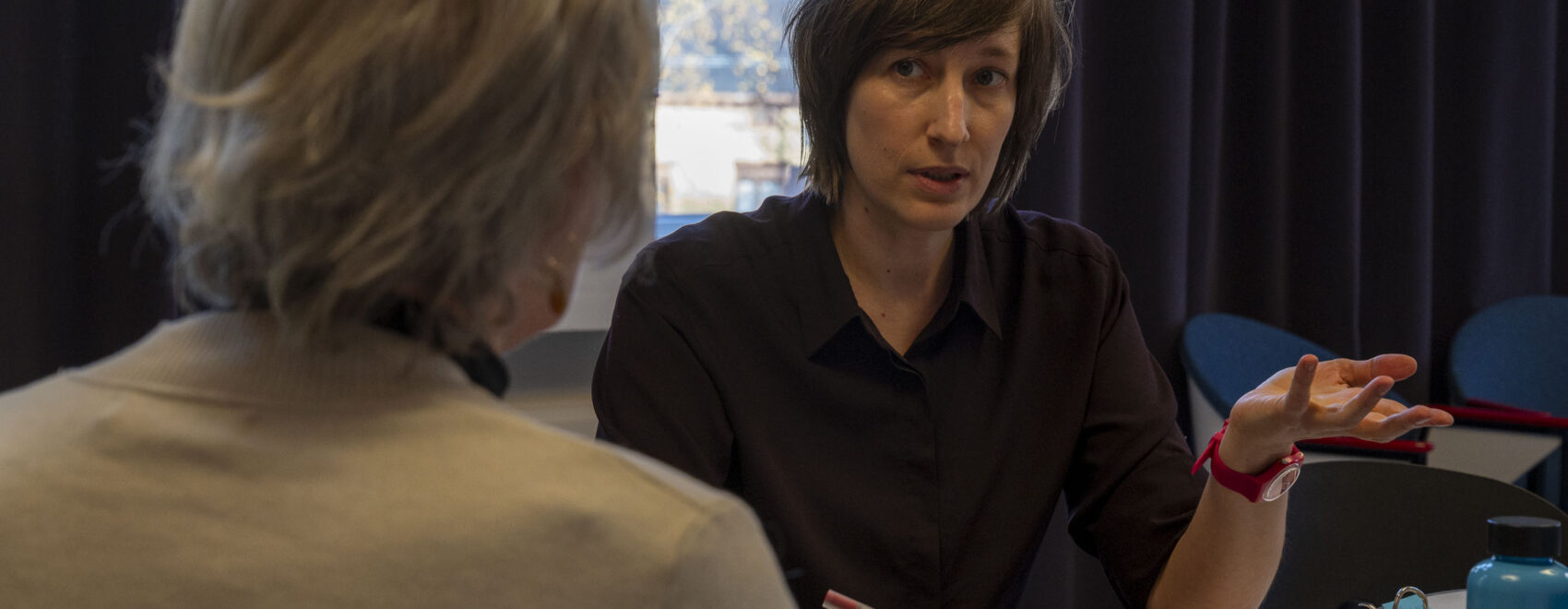
Eva Nina Lampič Interviews herself about her one-to-one piece Inside, a reconstruction of a past or future dream created from the audience’s memories and imagination, and especially about the ways of creating collaboratively with the one person audience. What meanings do score, game, improvisation and control take in one-to-one setting?
The text was originally published in Eva Nina Lampič’s substac account Behind open doors, where you can find also other interesting writing about her work. Pictures Anniina Kettunen
Ok, so a few months ago you’ve posted a score with basically no context. I was confused – was it connected to the new piece you were working on?
Yes and no.
Thanks, haha!
Yes, because the score is from the time when I was studying in Sheffield and first encountered the term “one-to-one performance”. No, because the new performance is very different from that score, but there are some shared core interests. So, to some extend, the new performance builds upon that score.
Why did you share it?
As you know, I always like to make the origins and connections of ideas visible.
But in general, I like scores, and I thought I might start a sub-section here on the blog. I have more that I could share.
So, how are the pieces connected? What is the difference? What has stayed with you for more then 10 years that you still want to continue? I find that a long time to stay interested in something.
There was something at the very core of that game that I liked so much, that I have been trying to find a place for it or develop it further ever since. But it never really fit anywhere.
Sorry – but now you are talking about a “game”? Are you still talking about the score?
Yes, I called it a performance back then, but from today’s perspective, I would call it a game. It was in fact a game, because it was very open-ended – more like a guided improvisation, let’s say. It was a research into what interests me in a one-to-one setting.
It was about sharing control and not being totally in charge – I guess this is the biggest difference that I am much more in control in the new piece.
And I really wanted to create something that was “impossible to create without the collaboration of the other.” And it was super important to me “that we both shared a situation of unexpectedness,” on as equal a footing as possible. These were my basic starting points at that time, and traces of them can also be found in the new piece.
Just a short intermezzo,
for anyone who is completely lost what are we talking about -“One to One Score Game” is an improvisation game for two people, who take turns in suggesting various imaginary interventions in the surrounding space, in order to create an imaginary world. The “new piece” is titled Inside1 and it is a one-to-one piece framed as “a reconstruction of a past or future dream created from the audience’s memories and imagination.” You describe it as “a collaboratively developed imaginary travel with possible and impossible people, objects and places.”

Ok, back to the comparison.
Today, I realise that if I want bring the piece to a more precise point, I need to take more control. If it stays on the level of improvisation, you never really know where or how far you will get, if you are honest and open in improvising and sharing the control. For Inside, I wanted to have more control over how the piece develops, what I offer to people and the kind of journey I take the audience on. So I couldn’t let the audience have complete freedom over the material they brought in or imagined: I clearly limit the pool of freedom they had.
At Game-Score the control is shared equally, in terms of the material brought to the game. I only provided a starting point, after which it became like a tennis game, with each of us reacting with an idea in turn. With Inside, I only ask for fragments of information about people and places, which I then blend with my own proposal.
So, the overall dramaturgy stays the same, but each performance is unique to its audience. This is still the trace of my desire to create something that cannot be done with anyone else, but with that specific person.
To an extent that only the audience knows exactly how the performance looks and who is in it. Even how I see it, it’s only my imagination based on what they tell me.
This sounds very elusive and complicated.
Haha. In practice, however, I think it’s really the opposite. The audience enters a very mundane, everyday situation, but then the events develop in a way that is perhaps different to what was anticipated and expected. I just realised that this is a principle I like to use a lot.
Is there still an element of surprise in the piece for you?
Yes, but it’s more about the details of how things look and the qualities of objects and reactions.
In case anyone is still wondering, “one-to-one” is a performance for one performer and one audience member at a time.
Yes, and I am that performer in Inside.
Do you have more empathy for actors now?
Absolutely. This is the first time I’ve had so many repetitions – I am currently at 23, and I’ll be soon close to 50 after the next festival. So, yes, I can definitely see how performing changes over time. After first five I felt, ok, now I am ready, and after ten, I really started to enjoy it and have fun at a new level. I had more trust that it would work, and even if something small goes wrong, I know how to either save it or continue.
I now understand much more what it means to feel comfortable with the material. I have a new understanding of rehearsals, practice, and repetitions. I remember how completely lost and insecure I felt after the work-in-progress showing at the residency, even though the external feedback was that I have things well under the control, and I knew that the overall structure worked.
So, now you can do it on the autopilot?
Not really. There are parts of the show where I have to improvise on the spot, so I have to be fully present, if I want it to go well. But there are parts that add to the character, if I perform them more automatically. I guess it’s a good combination.
After the first round of 23, I also see where I can play around more with the material I get from the audience at the time. And for people I also know in real life, I have started to collect strategies for how I react to them.
Additionally, I think I understand doctors better, or any job that has a new customer on short intervals.
How many times can you perform in one day?
Each performance last around 25 minutes, and in a festival setting I can perform it up to nine times a day. The maximum so far was 11 performances, which felt a bit much, but is also doable as an exception.
How do you sustain your presence during multiple one-on-ones? How do you recover?
Well, each new person gives me fresh energy. I noticed the difference; rehearsing with known people was much more difficult. Again, I can relate to actors and understand how performing in front of a known team and an empty hall can become exhausting and uninspiring, and how the audience can change all of that. But yes, it’s also a bit like Groundhog Day: you are caught in a loop, which is definitely a funny and unique experience.
But also, when I was designing the piece, I thought about how to structure it so that it doesn’t get too exhausting and stays fun.
What can you achieve in a one-to-one performance that you can’t do in a larger theatre production?
The unique thing about it is the specific level of equality established between the audience and the performer. To some extent, you meet as two individuals. You cannot really hide as a person, even though I create a very fictional situation. I guess that’s something I like very much. There is a level of honesty and an inability to pretend that I can relate to. Perhaps that is more difficult to achieve on larger scale?
In the case of Inside, I think, it has something to do with the precision with which I was being able to switch between different layers and performative realities, as I call them. It was about negotiating between what is here and now, what is imagined and what comes from the in-between, the more supernatural – and perhaps, because it is a micro-scale performance, it is easier to control, guide and navigate more precisely. Additionally, because parts of the story are custom-made for the audience, the person is perhaps more personally immersed in the story, so the switching has a stronger effect?
Could it also be that it suits your introverted nature better?
Of course, that could also be a factor. I only realised later with age that bigger groups give me a layer of anxiety. I have to say that the one-to-one festival has a unique atmosphere, not only because everything is more boutique, but you also need to have at least a small part of introvert in you, if you are participating, and that creates a unique atmosphere among the performers too.
Though I heard that idea of a one-to-one performance sounds scary to some and that people wouldn’t go. When I asked why, they said it was because they were afraid of being trapped and unable to leave. If I didn’t like it, would I dare to leave?
That’s an interesting point, I hadn’t thought of that before. Personally, I don’t find it scary, but then again, I am a professional in the field. And it’s true that if I go to see a one-to-one performance, I do go with a different level of attention and awareness. But it is a reasonable doubt and a topic, we haven’t spoken about yet: risk. There is a level of risk in one-to-one performance for both the performer and the audience. As much as you can potentially feel more free as an audience member (nobody is watching you, so you have privacy), you can also fall into the trap of trying to be a good audience member and doing what you think is expected of you. You might do something, because you feel you don’t have a choice, and might feel bad afterwards. So yes, be aware of your role as an audience member. But isn’t this also the case when you are part of a bigger group? Whatever you watch, you still have to be constantly aware of what the performance or any art form is trying to say, do or communicate to you, and whether you accept it, are aware of it, go with it or question it.
However, it’s easier for an individual audience member to be manipulated, and as performer, you need to take that into account and be aware of your own power.
It’s a very intimate form, for better or worse.
True.
This is why, in my case, it is very important for me to create a clear framework, especially since I ask people some quite personal, intimate questions. It was important to me that I didn’t need to know everything, but rather that I know fragments, and that I play with absurdity and coincidence.
Where can I see it?
Next week, I will be performing at the One to One Festival in Oeiras, and hopefully it will continue to have a life beyond that. Perhaps at other one-to-one or experimental festivals, or for smaller groups I can also do it on my own. Or collaborate with other one-to-one performances to create a small scale, portable festival.
Inside was developed during the One to One Art Residency 2025 at Kuća Klajn/House of Klajn (Klanjec, Croatia) and in collaboration with Kehä Festival (Ilme; Oulu, Finland) and One to One Festival (Gato Escaldado; Oeiras, Portugal).